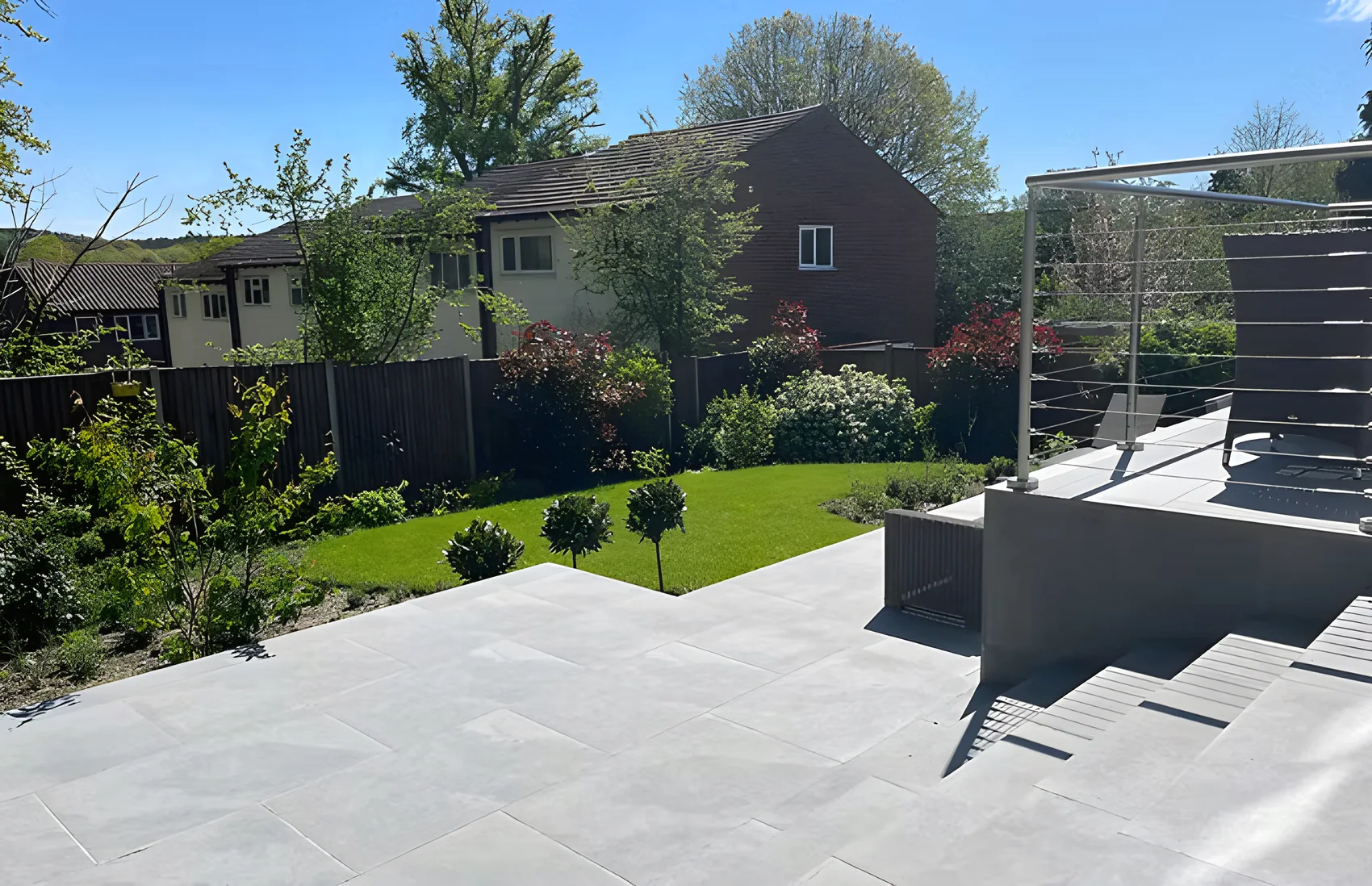
Show garden · RHS Chelsea 2024
A Rill, Pleached Trees and a Silver Medal at Chelsea.
The Bridgerton garden, sponsored by Netflix and designed by Holly Johnston, built by our own team and awarded a Silver Medal.
The Bridgerton garden
Water in a Straight Line, and Trees Trained Flat.
The Bridgerton garden was designed by Holly Johnston, sponsored by Netflix and built at the RHS Chelsea Flower Show in 2024. It was awarded a Silver Medal.
A show garden is a formal piece of construction with nowhere to hide. Nothing has grown in to soften a level, so a rill either sits level along its whole run or it does not, and everybody walking past can see which. Every surface is read close up.
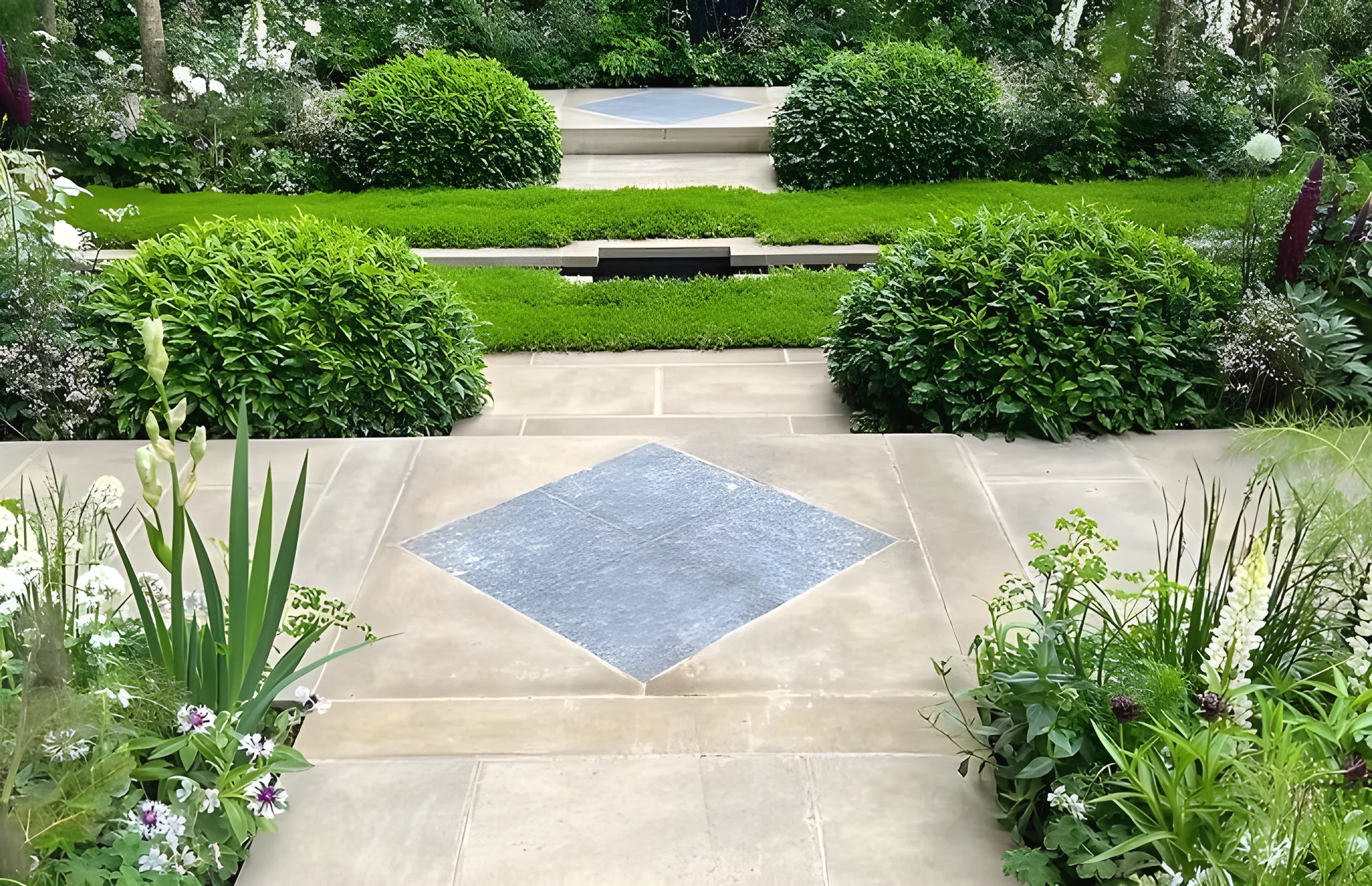
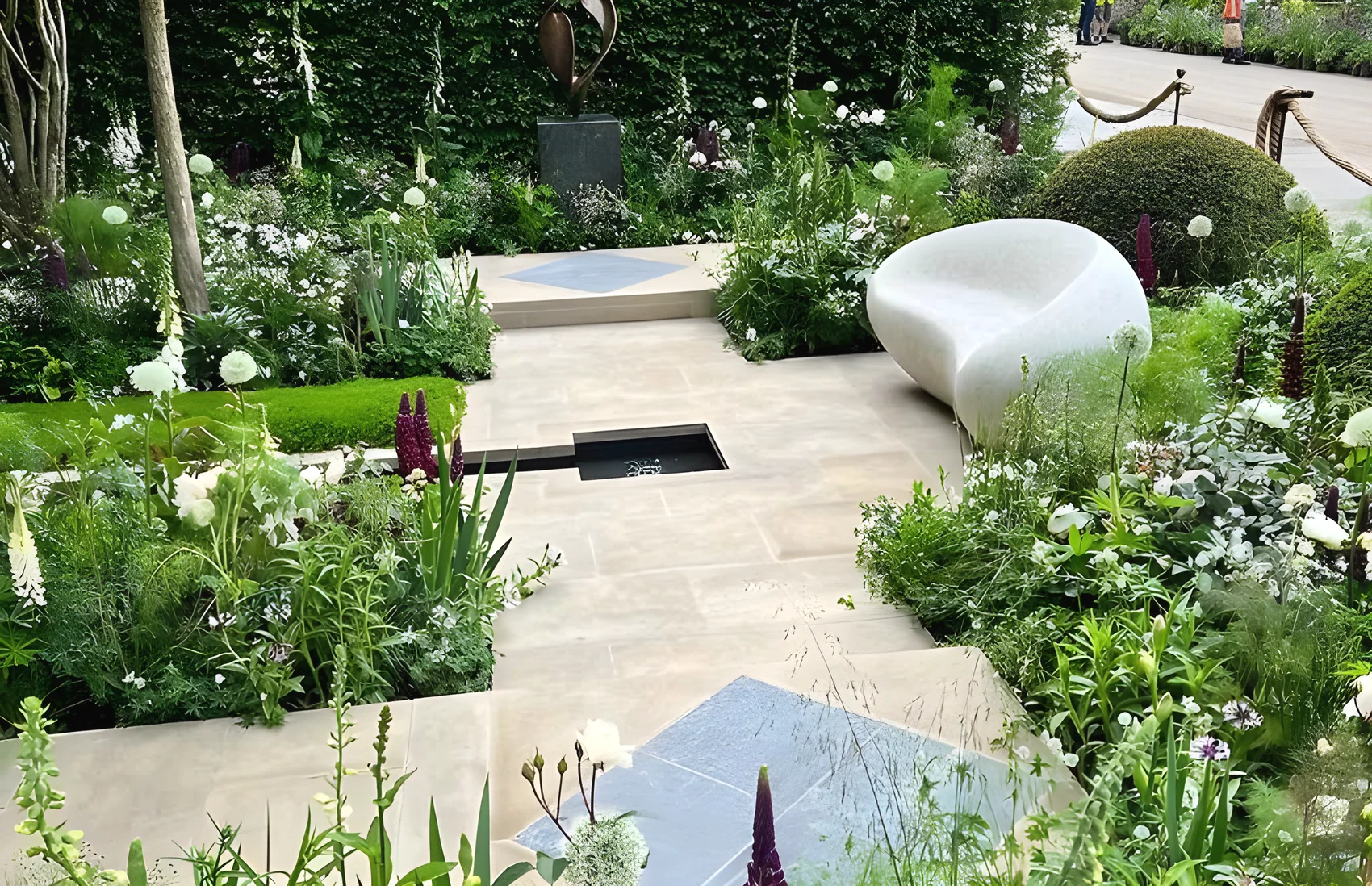
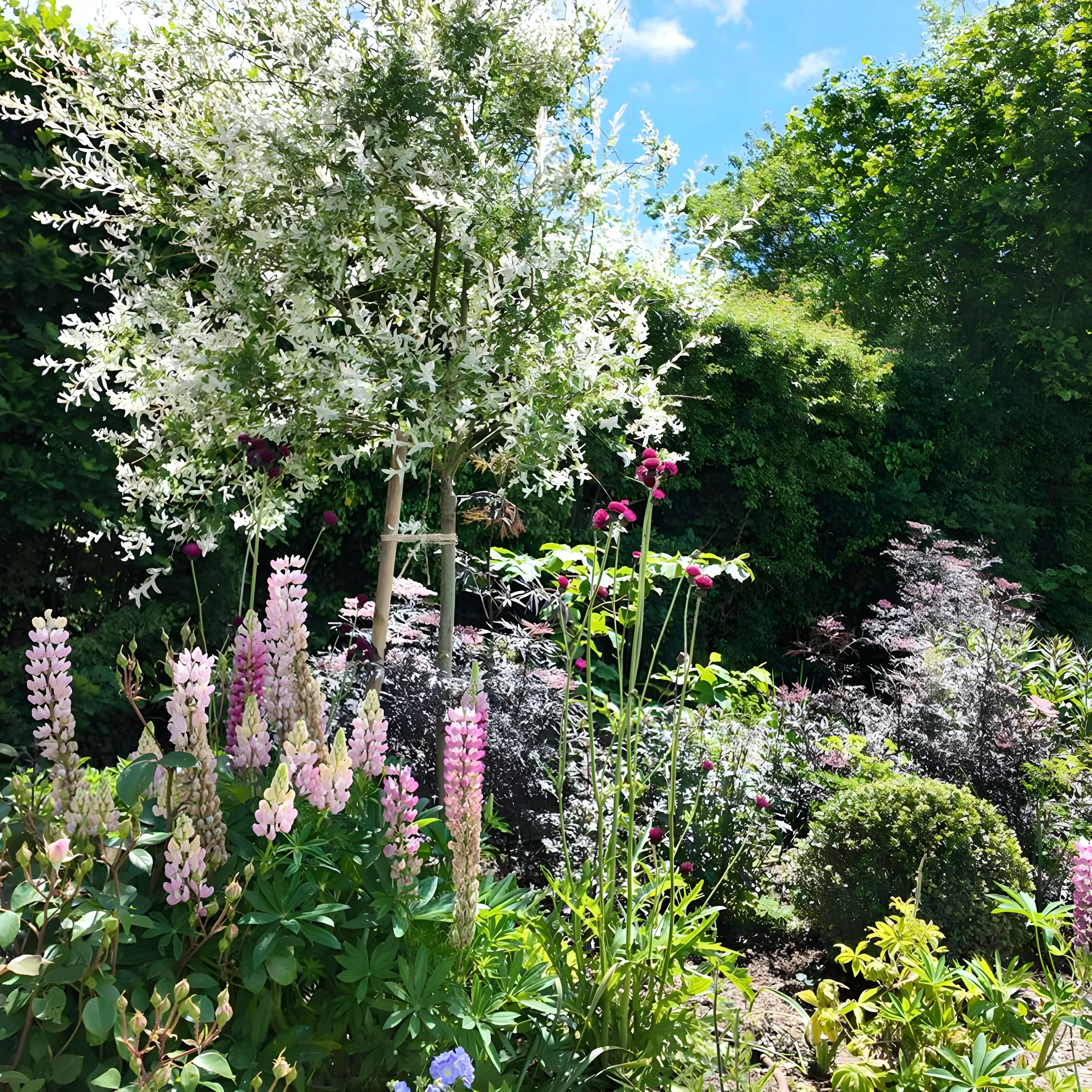
What is in the photographs is what the garden is made of. A rill running between pleached trees, a still pool holding a reflection, stone paving with a band set into it, clipped box giving the whole thing its shape, and perennial planting coming over the edges. The same team that set all of that out builds private gardens in Surrey the rest of the year.
- Water
- A rill, and a still pool
- Trees
- Pleached, trained flat on clear stems
- Evergreen structure
- Clipped box
- Paving
- Stone, with an inset band
- Seating
- A bench on the stone paving
- Planting
- Perennials carried to the paving edge
The rill and the pleached trees
A Rill Is Only Water, Until You Ask It to Sit Level.
A narrow channel of water runs between pleached trees, and the whole effect depends on two edges staying parallel and staying level. Both of those are setting out rather than planting, which is why a rill is a hard landscaping job before it is a water feature.
Water is the most honest spirit level there is. It finds the low point of a coping and sits as a wedge against it, so a rill is built to the edge rather than to the floor. The result is water sitting flat between two stone edges, which is the whole test of a rill.
Pleaching means the heads are trained flat and held there, so the clear stems below have to line up as carefully as the paving does. In this garden they run beside the rill, which is why the two read as one piece of setting out.
- Water shows every error, so a rill is judged along its edges
- Water built to the edge of a rill, never to the floor
- Pleached heads held flat, so the clear stems below read as a line
- Pleached trees run beside the rill
Paving, box and the bench
A Formal Garden Is Set Out From the Middle, Never From the Edges.
Stone paving runs up to a bench here, with clipped box holding the line beside it. It looks simple, which is the point, and simple is the hardest version to lay.
Work in from the boundary and the pattern arrives wherever it happens to arrive, usually with a thin sliver against one wall. Set out from the centre lines instead and the stone lands symmetrically, the cuts split evenly left and right, and the awkward ones end up where the planting will cover them. Joints are kept to one gauge the whole way through, and every cut is made on a saw rather than snapped.
The box is what holds the drawing when the perennials are between flushes. Plants are sorted for height and for their best face before anything is planted, set to a line, then clipped as a run rather than one at a time so the top reads as a single surface. The bench matters for the same reason the rill does. A seat tells people where to stop, so the paving is set out around it instead of being cut to fit it afterwards.
- Set out from centre lines so the cuts fall evenly
- One joint gauge across the whole surface
- Every cut sawn, never snapped
- Stone paving laid up to the bench, with clipped box holding the line beside it
- Box sorted for height and face, then clipped as one run
The inset detail
The Detail That Takes Longest Is the One Nobody Mentions.
A band of stone is set into the main paving, with perennials spilling over the edge of it. Nobody looking at the finished garden says anything about that band, and that is the compliment.
Inset work is all cutting. Every piece has to agree with the gauge of the paving around it, and the junctions have to be worked out rather than discovered. The joints have to read as lines rather than as bands, and the smaller pieces have to sit as solidly as the big ones.
The planting is doing half the work here. Perennials are chosen and placed to come forward over the stone, which only looks relaxed if the bed has been set a little below the paving. Then the plants rise to meet the edge and lean across it, instead of sitting up on top of it with a line of soil showing underneath.
- Every piece cut to agree with the gauge of the paving around it
- Junctions worked out, not left to chance
- Joints reading as lines rather than as bands
- Small pieces bedded as solidly as the large ones
- Perennials coming forward over the edge of the stone
Good to know
Questions About This Garden
Did CJ Landscapes Design the Bridgerton Garden?
No. It was designed by Holly Johnston and sponsored by Netflix, and we built it. That is a normal way for us to work. Some clients come to us with a designer already appointed and we build their scheme, and others use our own design service from the first sketch to the final plant.
What Does Building a Show Garden Have to Do With My Garden at Home?
A show garden is the same materials and the same trades as a private garden, with the finish inspected at close range and no second chance at it. The habits that come out of that do not switch off afterwards, because the people who set out the rill and the paving here are the people who turn up to a garden in Camberley or Virginia Water. It is also why we would rather talk about levels and drainage at the first visit than about furniture.
What Did CJ Landscapes Actually Build in This Garden?
The rill, the still pool, the stone paving and its inset band, the clipped box and the perennial planting. The garden was designed by Holly Johnston and sponsored by Netflix, and it was awarded a Silver Medal.
Will Planting Look Like This on the Day It Goes In?
Show planting is brought to the garden at the moment it is performing, which is not how a private garden is planted. A garden scheme is installed to mature, so the first season is about root establishment rather than effect, and the structure carries the garden while the perennials catch up. Clipped evergreens like the box in these photographs are what hold the shape in the meantime.
Who Actually Builds the Work, and Is Any of It Subcontracted?
Our own team. The same people design, build and then look after the gardens. Nothing in this garden was put out to a subcontractor, and nothing in yours would be either.
Related services
The Work Behind It
- Landscape ConstructionTerraces, paths, levels, retaining walls and outdoor rooms, built in house from groundworks to the final joint.
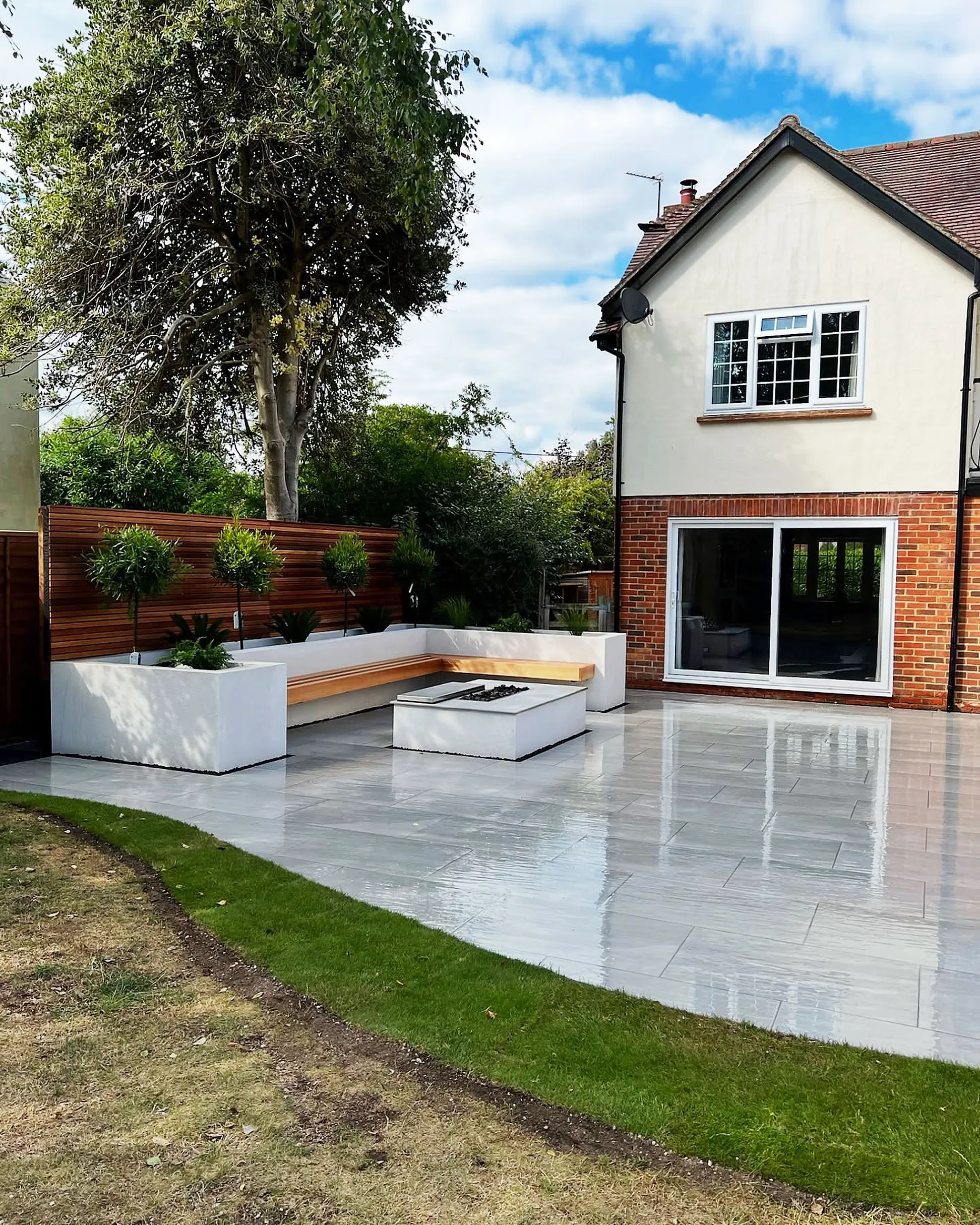
- Garden PlantingPlanting schemes shaped around soil, light and season, installed to mature naturally and stay manageable.
- Garden DesignSurvey, concept and planting plan, drawn around how you actually want to use the garden and what the ground will support.