
A CJ Landscapes guide · Surrey and Hampshire
How to Choose a Landscaper, and What to Ask Before You Say Yes.
Most of the risk in a garden project is settled before anyone picks up a tool, in who you choose and what gets written down. The questions that matter most are the ones asked least: what sits under the terrace, where the winter water goes, and who comes back in year two.
A garden build is one of the larger jobs a house ever has done, and it is the one with the least paperwork behind it. Anyone can print cards and call themselves a landscaper. There is no licence to lose.
So the work of choosing well falls to you, and it is mostly done with questions. A handful of them separate serious contractors from the rest quite quickly, because a firm that builds properly can answer them without hesitating, and a firm that does not cannot.
This is written by a contractor, so read it with that in mind. We have tried to be straight about where a firm like ours is the right call and where it is not.
In short
- Quotes to compare
- Three, all priced from the same drawing and the same written specification.
- The question that tells you most
- What is the build up under this terrace, and where does the water go?
- Ask to see
- A garden finished two or three years ago, not photographs from handover week.
- APL membership
- A trade membership you can verify on the association's own member list. It is not a warranty on your garden.
- In house or subcontracted
- Ask who lays the paving, who runs the programme and who comes back in year two.
- Walk away when
- The price is one figure, the deposit covers most of the job and cash is preferred.
Work Out Which of Three Jobs You Are Buying
Landscaping covers three different trades that often share a van. Design is drawing: survey, levels, a planting plan and a specification somebody can price. Construction is building: groundworks, drainage, levels, hard surfaces and structures. Maintenance is the years afterwards, which is where a garden is either kept or quietly lost.
Plenty of good practices only do one of them. A design studio that does not build will hand you drawings to put out to tender, which is a sound route and often the right one for a complicated garden. A construction firm that does not draw will want a design from somebody else before it can give you a real price.
Decide which you are buying before you ring anyone, because it changes who you should be ringing and what a fair quote even looks like. If you want one firm to carry all three, say so in the first conversation and ask directly whether the design, the build and the aftercare are the same people or three separate sets of them.
We do all three with our own team. Clients also arrive with a designer they have already chosen and ask us to build that scheme, and that works just as well. What does not work is assuming the drawing and the build are the same purchase.
The Questions That Sort a Serious Contractor From the Rest
None of these are trick questions. A contractor who builds properly will answer them off the top of their head, usually at length, because they are the things they think about all day. Hesitation, vagueness or a change of subject is the information you came for.
Ask them on the first site visit, while you are both standing in the garden. The answers are far easier to judge when they are about your ground rather than in the abstract.
Write down what you are told. Three contractors blur together within a week, and the one you remember as impressive is not always the one who answered the question about drainage.
- Who will actually be on site, and who runs the job day to day? Ask for the name of the foreman.
- Is the build done by your own employed team or subcontracted, and which parts of it?
- What is the build up under this terrace, and why that depth on this ground?
- Where does the water go? Surface water, downpipes, and what the lawn does in February.
- What are the levels doing? How many steps, where are the retaining structures and how are they built?
- Can I see a garden you finished two or three years ago, rather than photographs from handover week?
- What is not in this price, and what have you allowed a sum for rather than properly priced?
- Who is responsible if the paving lifts in year two, and what exactly does that cover?
- Can I have your public liability and employers liability insurance in writing?
What a Real Quote Looks Like
A quote is not a price. It is a description of the job with a price attached. If you cannot tell from reading it what will be built, in what, to what depth and in what order, then there is nothing to compare and nothing to hold anyone to later.
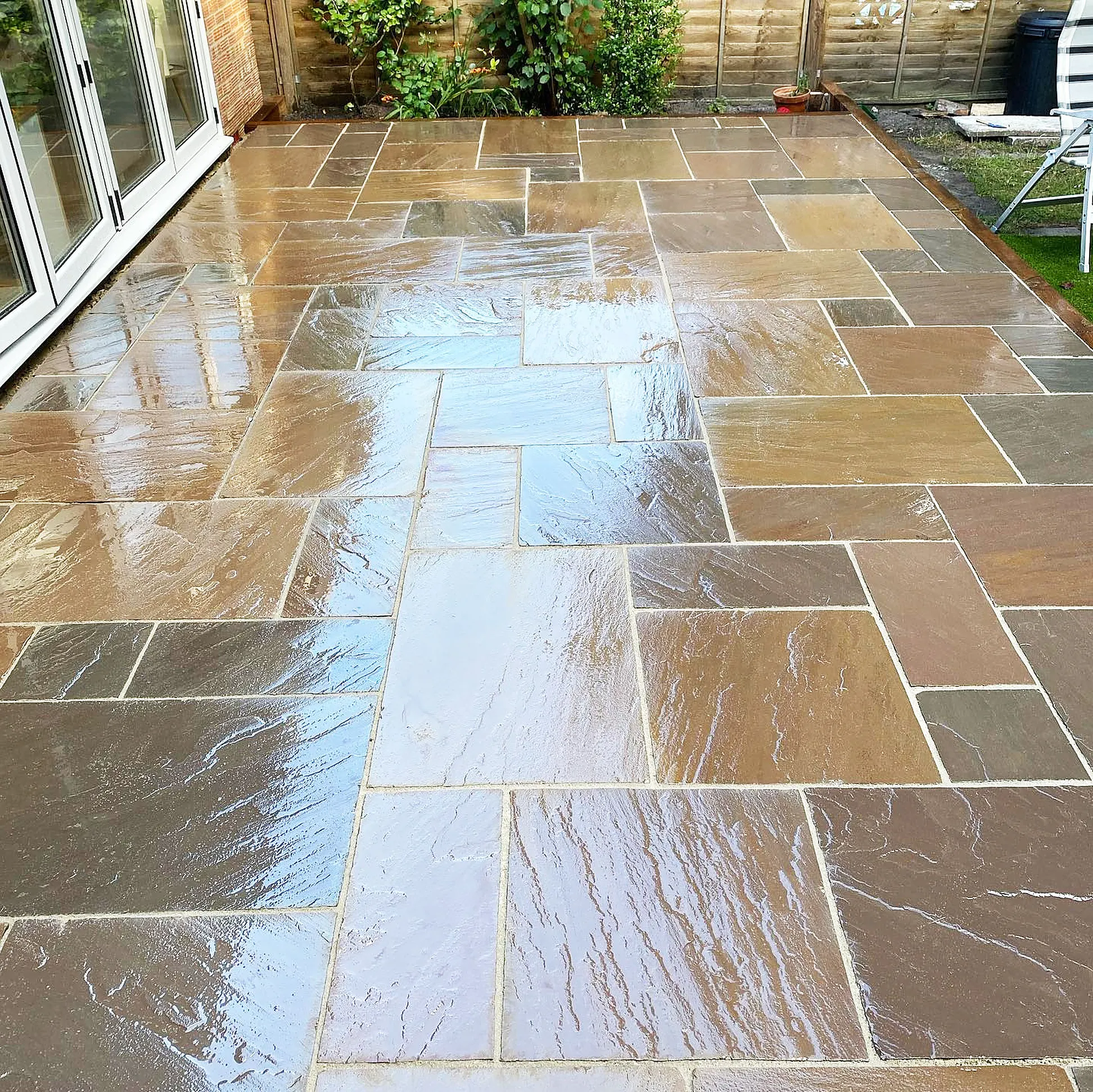
Expect several pages. Expect materials named properly: the paving by range, format and finish, the sub base and its depth, the mortar, the edging, the sleepers or blocks in a retaining wall, the pipe sizes in a drainage run. Expect excavation and waste removal to be priced, because on most gardens the digging and the lorries are a real share of the cost and the first thing a thin quote leaves out.
Expect exclusions in writing. Honest quotes carry them: unknown ground conditions, services found during excavation, a structural engineer where a wall needs one, work you have asked another trade to do. A quote with no exclusions is not a braver quote, it is a vaguer one.
Then compare like for like. If one quote describes the drainage and another does not mention it, you are not looking at two prices for one garden. You are looking at two different gardens.
- Itemised sections you can read and compare, not one figure for the whole garden.
- Materials named by range, format and finish, with the sub base depth and the laying method stated.
- Excavation, waste removal and site protection priced rather than assumed.
- Levels, drainage and retaining structures described, with anything needing an engineer flagged.
- Allowances and provisional sums marked as exactly that, so you can see what is still a guess.
- A payment schedule tied to stages of completed work, with VAT shown clearly.
- An indicative programme in weeks, and the name of the company you are actually contracting with.
Why Two Quotes for the Same Garden Come in Thousands Apart
Almost always it is what you cannot see. Two terraces can look identical on the day they are finished and be completely different pieces of work underneath.
The gap usually sits in the build up: how much soil came out, how deep the compacted stone is, whether the slabs are laid on a full mortar bed or dabbed onto five spots, whether there is a drainage layer or a pipe at all, whether the retaining wall has a proper footing and weep holes or is a line of blocks holding back wet clay. On the heavy ground across much of Surrey, that difference shows itself in the second or third winter rather than the first.
Labour is the other half of it. A priced week of two experienced hands is not the same week as four people still learning the trade. Neither is wrong, but the cheaper week usually buys fewer finished square metres and a rougher joint.
When quotes are far apart, do not simply take the middle one. Go back to the cheapest firm with the specification from the most thorough one and ask them to price that instead. Either the price moves and you have learnt something, or it does not and you have learnt more.
What APL Membership Actually Means, and What It Does Not
The Association of Professional Landscapers is a trade association for landscape contractors. We are members. What the association does and does not check is set out on its own website rather than ours, and that is the place to read it, because a contractor summarising its own trade body is not evidence of anything.
What that tells you is genuinely useful and genuinely narrow. It is a name on a published list, which you can look up in a minute. A firm with no listing anywhere gives you nothing to look up, and that is the useful part.
What it does not tell you is whether your garden will be built well. It is not a warranty, it does not vouch for a particular project, and it has no opinion on whether a design suits your house. There are excellent landscapers who have never joined, and membership is no reason to skip a single question in this guide.
We are members, and the practical thing we would say to anyone comparing firms is this: check the claim. Associations publish their member lists, so look the company up on the association's own site rather than trusting a logo on a website. A logo is artwork. A listing is a fact.
What Reviews and Listing Sites Are Worth
Reviews are strong evidence of behaviour and weak evidence of workmanship. They will tell you reliably whether a firm turned up when it said it would, cleared up at the end of the day, answered the phone and handled a problem without a row. That matters, and it is most of what goes wrong on a domestic project.
What a review almost never tells you is what is under the paving. Clients rate the experience they had, not the sub base they cannot see, and paving that was always going to fail still looked beautiful on the day somebody wrote about it.
Listing sites such as Checkatrade, which we are listed on, collect and publish what customers say about a firm. Whatever a listing site does or does not verify is set out in its own terms, and either way it is a different thing from standing in a finished garden and looking at the work.
So read the middling reviews rather than the glowing ones, and look at how the firm replied to them. Then ask whether you can see a finished garden in person and whether the owner would be happy to talk to you. Most firms with nothing to hide will arrange it.
In House or Subcontracted, and What It Changes
Subcontracting is not a dirty word. A crew that lays one material all week is better at it than a generalist, and firms of any size bring in an electrician or a structural engineer because the work requires one.
What matters is who holds the job together. With an employed team, the same people are on site from the first dig to the final joint, the foreman knows what was buried in week two, and the firm cannot point at a third party when something needs putting right. With a subcontracted model you want to know who manages the programme, who carries the risk, and whether the crew who built the garden is the crew who comes back to it.
So ask which parts are subcontracted, trade by trade. Then ask who is on site when two trades have to agree a level. If the honest answer is nobody, that is the thing that goes wrong.
Our design, build and maintenance teams are our own employees, which is why we talk about groundworks to the final joint as one job. It has a cost, and we would rather say it plainly: an in house team is not the cheapest way to build a garden, and we would rather give you a start date we can hold to than one that suits the conversation we are having today. We do use partners where a specialism genuinely sits outside landscaping. Japanese knotweed goes to our invasive weed partners at AIR8, and our deep soil aeration work uses the soil injection system engineered by VOGT, run by our own trained team.
How to Read a Portfolio, and What a Medal Does Not Tell You
Handover photographs are the easiest thing in landscaping. The paving is washed, the planting is fresh and nothing has been through a winter yet. A portfolio made entirely of them is a portfolio of first days.
Ask for the opposite. A garden finished three years ago will tell you whether the joints have held, whether the steps still sit level, whether the planting was chosen for the light it actually gets, and whether the lawn survived being lived on. If a firm cannot show you one, ask why not.
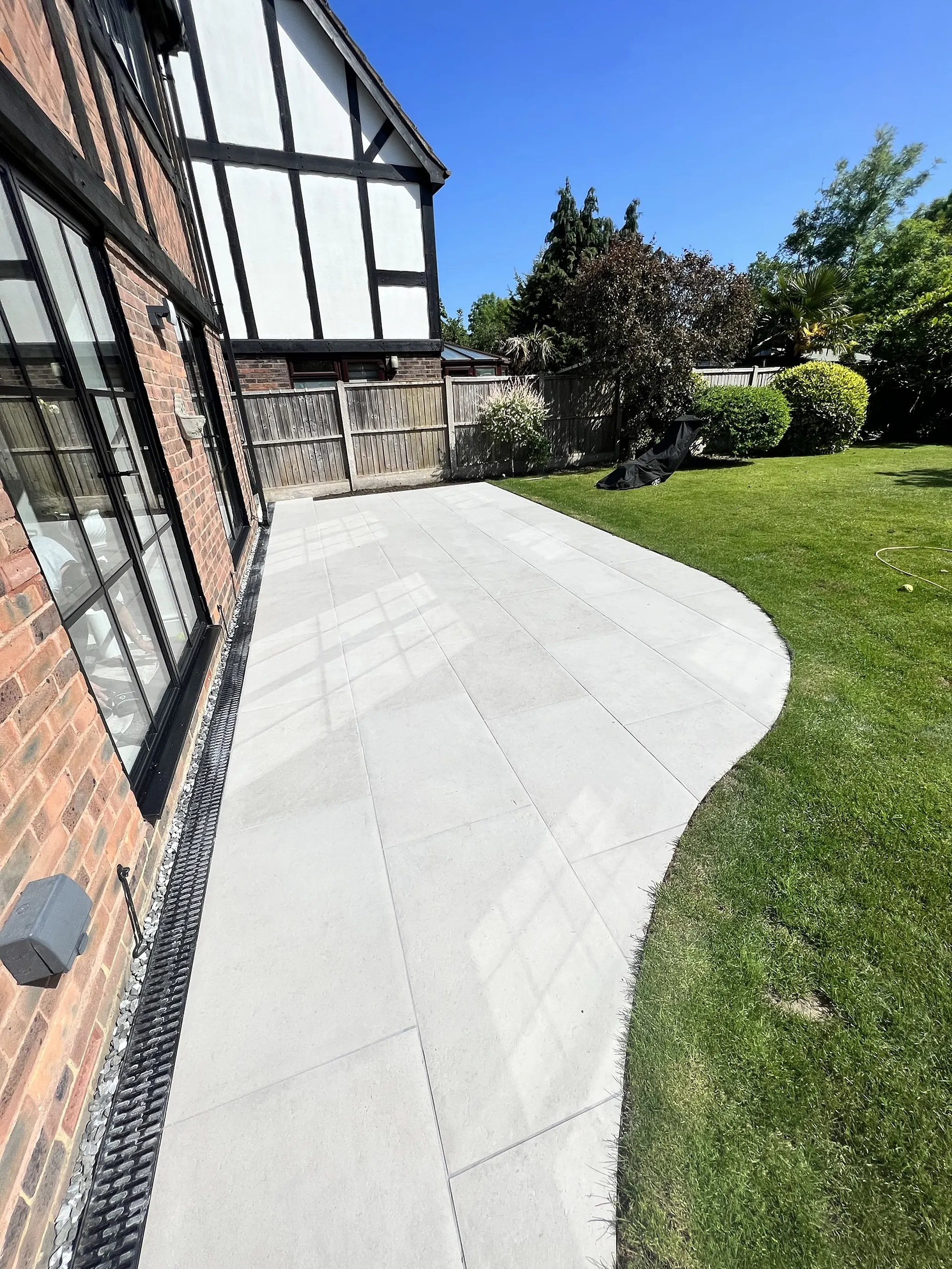
Look for your problem rather than your taste. If your garden falls steeply to the back fence, find a project with retaining walls and steps in it. If it sits on clay and floods, find a project where drainage was the job. Photographs of a flat terrace prove very little about a slope.
Show garden medals are worth something quite specific. We hold a Silver Medal from the RHS Chelsea Flower Show 2024, for the Bridgerton show garden sponsored by Netflix and designed by Holly Johnston, and a Silver Gilt Medal from the RHS Hampton Court Palace Garden Festival 2023. At the RHS Chelsea Flower Show 2022 we were part of the team that built the show garden voted the public's favourite. What a medal proves is that a team can build to a fine tolerance, at speed, with judges watching. What it does not prove is how that team behaves in month four of a build in a garden where somebody lives. Ask about the private gardens as well.
The Warning Signs
None of these on its own means a firm is bad. Two or three of them together is a reason to stop and get another quote.
The last warning sign is in you rather than in them. If a firm makes you feel awkward for asking about drainage, that will not improve once the diggers are on site.
- A single figure for the whole garden, with no written specification behind it.
- A price that lands exactly on the budget you mentioned, before anybody has measured anything.
- A deposit that covers most of the job. Paying for materials up front is normal, paying for the garden is not.
- A discount for cash, or for leaving the paperwork alone.
- No written exclusions, and no answer on what happens if the ground is worse than expected.
- Vagueness about drainage, usually phrased as sorting it out as we go along.
- No insurance documents, or an offer to send them on later.
- Pressure to sign this week, especially alongside a start date in the middle of the busy season.
- A trade association logo on the website that does not appear on that association's own member list.
- Reluctance to give you a single address of finished work you could go and look at.
Good to know
Questions We Are Asked Most
How Many Quotes Should I Get?
Three is usually enough, and they are only comparable if all three price the same drawing and the same written specification. Without that you are asking three firms to invent three different gardens and then choosing between the prices of jobs that are not the same job.
Is It Normal to Pay a Deposit Before Work Starts?
Yes. Materials for a garden build are ordered and paid for well before they are laid, so a deposit against them is standard practice. What is not standard is a deposit that covers most of the value of the project. Expect payments tied to stages of completed work, set out in writing, and expect a final payment that only falls due once the job is finished and you have walked it.
Do I Need Planning Permission for a Garden Project?
It depends on what you are building and where. Hard surfacing, raised terraces, retaining walls and boundary structures can all need consent, and a listed building or a conservation area usually changes what is needed again. Treat anything you read online, here included, as guidance rather than law, and check with your local planning team before committing. A good contractor will tell you when something looks like it needs consent instead of quietly building it.
Should I Pay a Designer Separately, or Use a Firm That Designs and Builds?
Both routes work. A separate designer gives you an independent eye and drawings you can put out to tender, which suits a complicated garden or a client who wants competitive prices on one fixed scheme. A design and build team keeps the drawing and the construction with the same people, so what gets drawn is what can actually be built. The route to avoid is no design at all, because a garden priced from a conversation is a garden nobody has thought through.
Is CJ Landscapes the Right Firm for a Smaller Garden?
Often not, and we would rather say so early. We are set up for substantial private gardens where design, groundworks, construction and ongoing care are all part of the brief. If your project is a small patio replacement or a one off tidy up, a good local contractor will serve you better and cost you less. Our garden maintenance plans start from £160 per month on a twelve month agreement, with a minimum four hour visit each month, which gives you a sense of the scale we are built for.
How Long Should a Garden Build Take?
It depends on the groundworks more than the finishes. Levels, drainage and retaining structures take the time, and weather, access and what the digger finds can all move the programme. The useful thing is not a promise of a number of weeks but a written indicative programme, a named foreman, and a contractor who tells you early when something has slipped and why.
Related services
The Work Behind the Guide
- Landscape ConstructionTerraces, paths, levels, retaining walls and outdoor rooms, built in house from groundworks to the final joint.
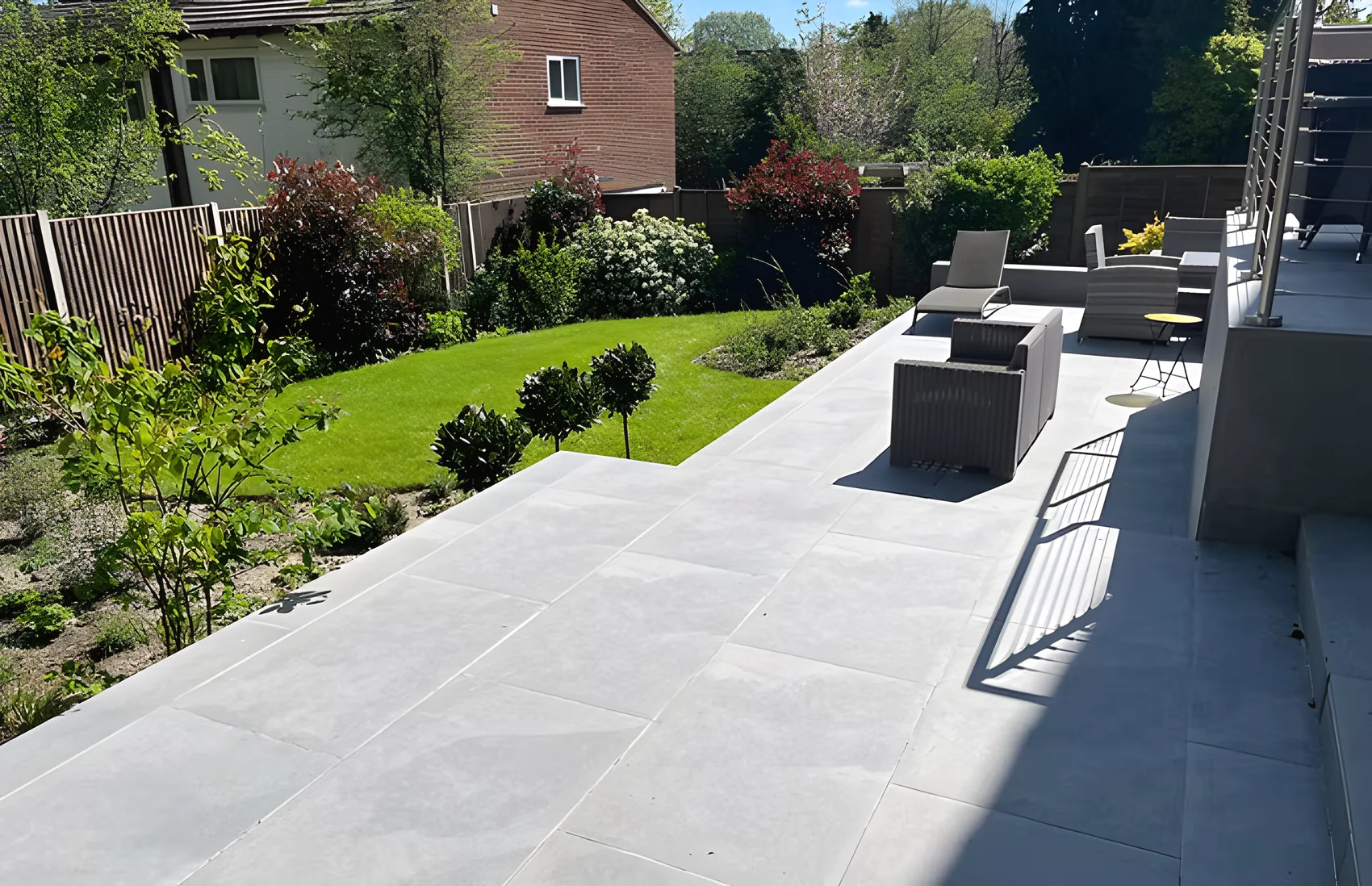
- Garden DesignSurvey, concept and planting plan, drawn around how you actually want to use the garden and what the ground will support.

- Garden MaintenanceA considered monthly programme that keeps a well designed garden healthy, tidy and developing properly over time.
Start your garden
Ask Us the Hard Questions, Starting With the Drainage.
If you are gathering quotes, we are happy to be one of three. Tell us what the garden does in winter and what you want from it, and we will tell you honestly whether we are the right firm for the job.
- 01We Call You BackWithin one working day, to talk the garden through.
- 02The First VisitA walk round the garden to take in the levels, the access and where the water sits.
- 03A Written ScopeA specification and a programme, with samples to see in your own light.
Hartley Wintney, Hook RG27 8NZ