C J LANDSCAPES Get in touch

Littlehampton, West Sussex · 2023

Charcoal Pavers, Pale Gravel and Grasses, With Planting Carrying the Design.

Two hard surfaces doing the floor, stone and steel holding the fixed points, and planting given the room to close over the rest of it.

Littlehampton, West Sussex

The Floor Is Paving and Gravel, Everything Else Is Planted.

This garden was built in Littlehampton, West Sussex in 2023. It is a small rectangle behind a brick house, and what it got is a planting led scheme: two hard surfaces doing the floor, a few fixed points in stone and steel, and planting carrying everything else.

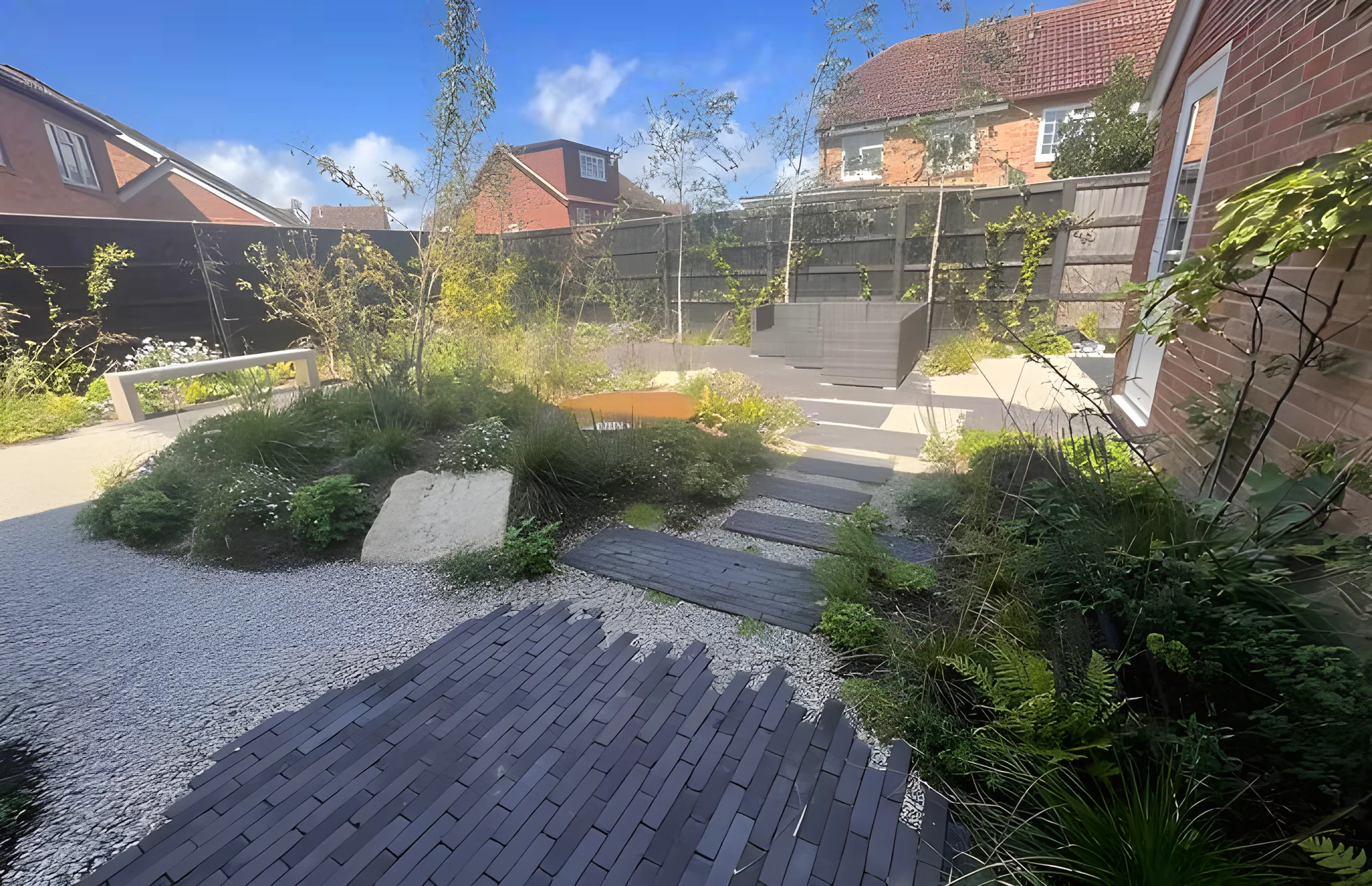
The two surfaces are brick sized pavers in charcoal and a pale angular gravel, and the line between them is a curve rather than a straight run. The paved terrace sits against the house, the gravel takes the rest, and bands of the same paver are set across the gravel to carry the route.

The beds are the garden. Grasses, ferns and low spreading perennials are planted up to the edge of both surfaces, climbers go up wires on the boundary fence, and a young tree with pale bark stands in the planting. Across these two photographs the floor is paving and gravel, and everything else is planted.

Paving
Brick sized pavers in charcoal, laid in running courses
Gravel
Pale angular gravel, with paver bands set across it
Seats
A pale plank bench and three stone blocks along the bed edge
Centrepiece
A round weathering steel bowl set low in the planting
Planting
Mounded grasses, ferns and low spreaders in mulched beds
Boundary
Climbers trained on wires across the fence panels

Where it started

A Lawn, a Fire Pit and Fence Panels, in an Enclosed Rear Garden.

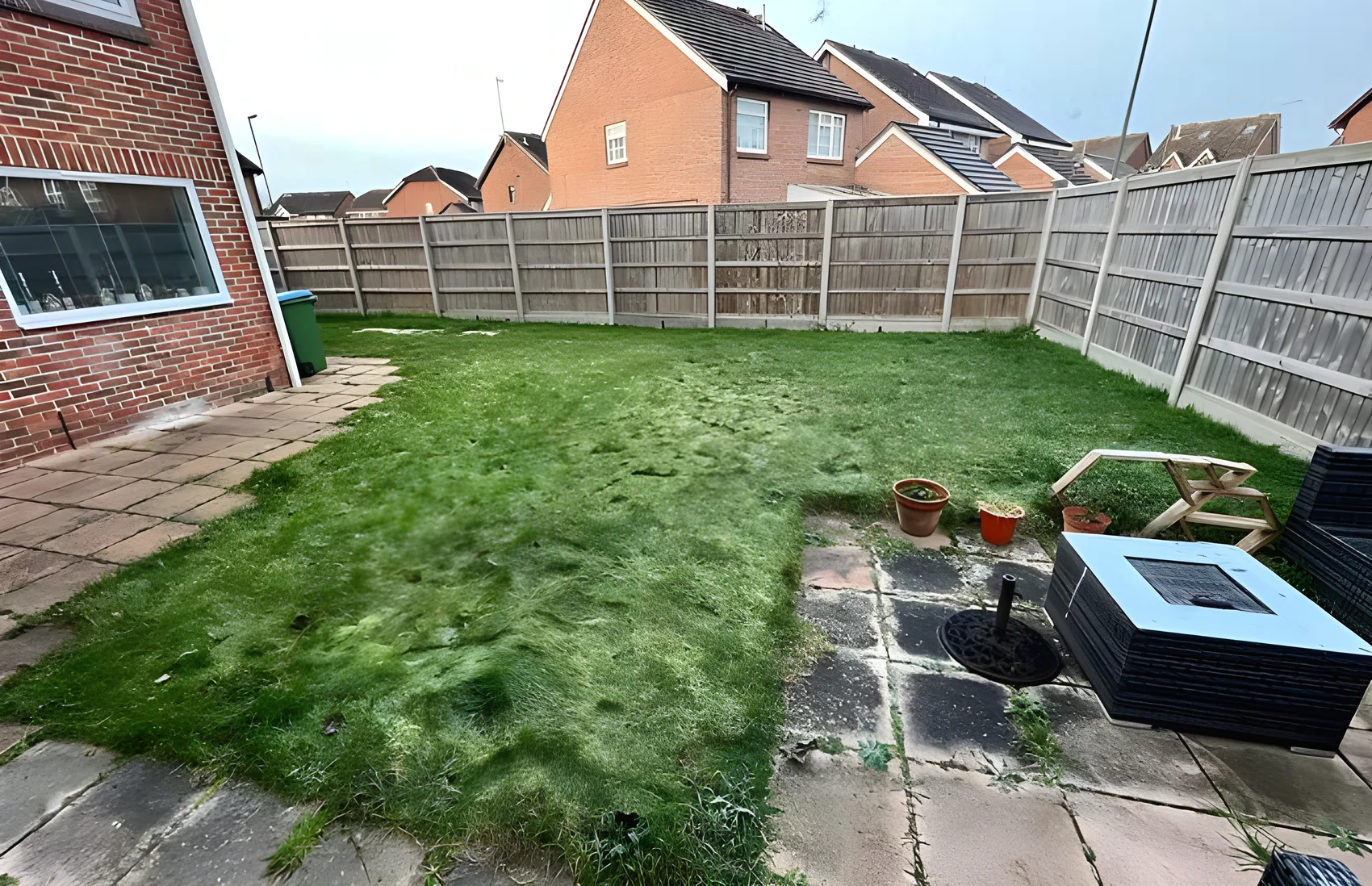
Before the build, this was a lawn and a fire pit in an enclosed rear garden. A run of slabs comes straight off the back of the house, fence panels on concrete gravel boards run from one corner to the other, and a parasol base and a few terracotta pots stand on the slabs.

Ground like that gives a landscaper three things to work with and not much else: the shape of the rectangle, the line of the fence and the way out of the back door. What the ground will take is worked out before anything is set out on it, which is how a garden avoids being built twice.

The fence counts for more than it looks. On a plot this size it is most of what you see from every window, so either it gets planted against and climbed over, or it stays the first thing anybody looks at.

The same garden in leaf

Grasses Over the Gravel, and a Route That Reads as One Floor.

In leaf the garden is mostly planting. Mounded grasses and low spreading perennials have closed over the bed edges, ferns have taken the shaded strip along the house wall, and climbers are away up the wires on the fence. The paving and the gravel are still doing the work underneath, but you notice them second.

The route across the gravel is bands of the same charcoal paver, set into it and spaced like steps. Using the floor material again, rather than bringing in a third one, keeps a small garden reading as one surface, and it leaves the gravel open to drain instead of sealing another path across it.

A large pale stone sits in the planting and the steel bowl is down among the grasses, both of them things that hold their shape when the perennials are cut back. A plain plank bench sits at the edge of the gravel. Across this part of the garden the floor is paving and gravel, and everything else is planted.

  • Grasses and low spreaders closed over the bed edges
  • Ferns in the shaded strip along the house wall
  • Paver bands set into the gravel to carry the route
  • A plain plank bench at the edge of the gravel
  • Climbers trained on wires across the fence panels
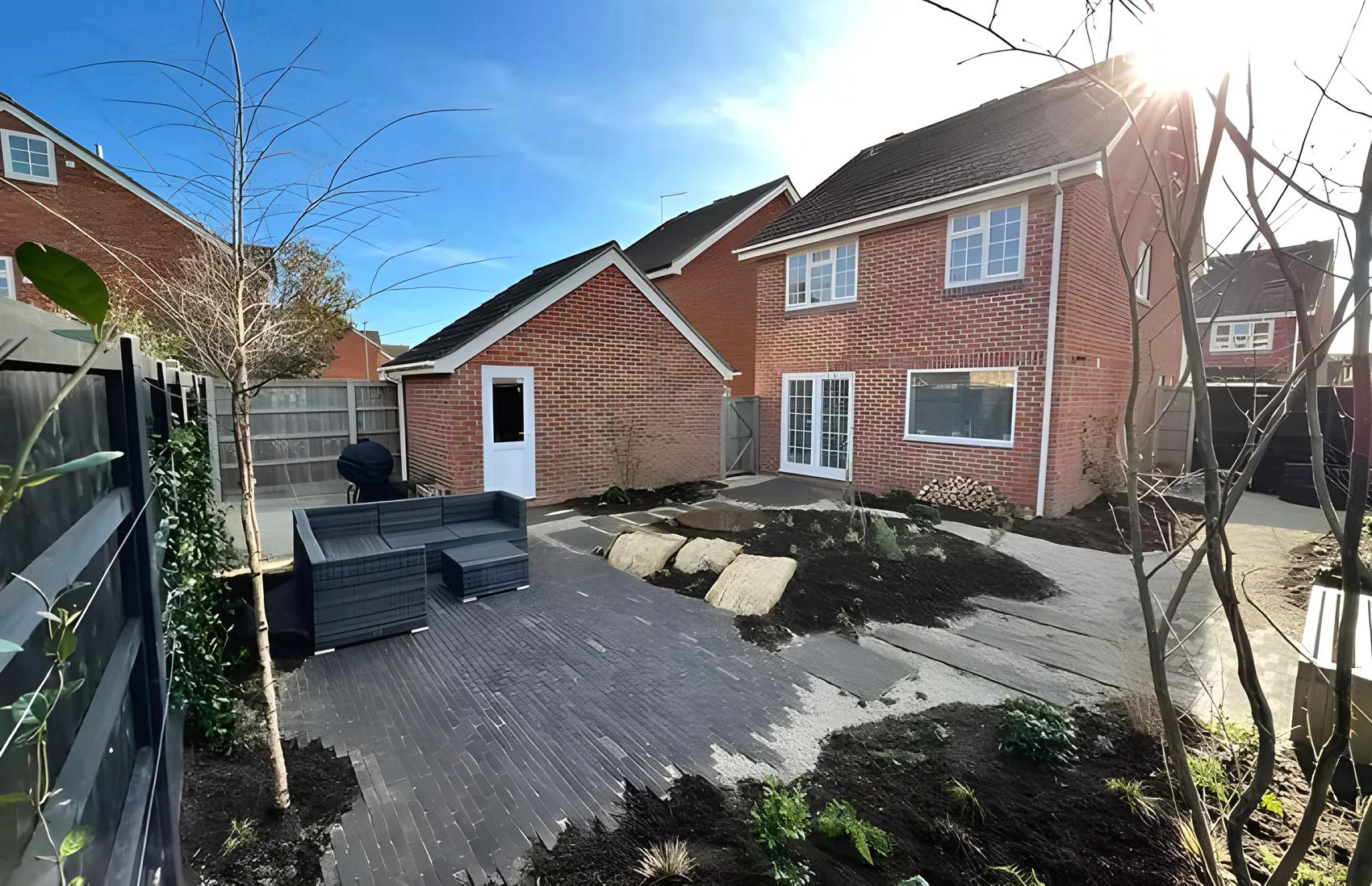
A new patio and planting behind a brick house

The work, newly finished

A Dark Floor Cut on a Curve, and Beds Left Room to Grow Into.

Here the building is done and the planting is still young. The floor is brick sized pavers in charcoal, laid in running courses, and its edge is cut on a long curve where it meets the gravel. Paving to a curve is slow: every course has to be cut to the line and each cut end has to finish square against the gravel, which is why most gardens get a rectangle instead.

Three pale stone blocks sit along the edge of the bed, half in the mulch and half on the paving. They are seats that never need putting away, and they hold the line of a planted edge that would otherwise be walked through. In the middle of the bed, a round weathering steel bowl sits low enough that the planting will grow around it rather than behind it.

The beds are mulched dark and the plants are small and set well apart, which is what a planting plan looks like before it closes. Spacing a bed for the size the plants will be, rather than the size they are, is the difference between a border that thickens up and one that has to be thinned out later. A young tree with pale bark is planted in the bed along the boundary.

  • Brick sized pavers in charcoal, laid in running courses
  • The terrace edge cut on a curve against the gravel
  • Three stone blocks set along the bed edge as seats
  • Beds mulched dark and planted for their mature size
  • A young tree with pale bark in the bed along the boundary

Good to know

Questions About This Garden

Is a Gravel and Planting Garden Less Work Than a Lawn?

It is different work rather than less work. Nothing needs mowing, edging or feeding to keep a stripe in it, but gravel wants weeding before anything seeds into it, grasses want cutting back once a year before the new growth comes through, and mulch wants topping up. Our garden maintenance plans start from £160 per month on a twelve month agreement, with a minimum four hour visit each month.

Why Are the Plants So Small and So Far Apart in One Photograph?

Because they are planted for the size they will be, not the size they are. A bed set out at final spacing looks thin for its first season and then closes on its own, instead of being lifted and thinned a few years later. Grasses and perennials generally fill quickly, shrubs and trees take longer, and a dark mulch over the bare soil holds moisture and keeps weed seed down while that happens.

What Stops Gravel and Paving Mixing Into Each Other?

Edges and levels. Gravel is generally laid a little below the face of the paving so it has somewhere to sit, with a restraint along the line, and both surfaces are built off a compacted base rather than straight onto soil. On the curve in these photographs every paver is cut to the line, so the gravel finishes against a hard edge rather than a crumbling one.

Does a Planting Led Garden Have Anything to Look at in Winter?

While the trees are still bare, what carries the garden is the pattern of the paving, the curve where it meets the gravel, the three stone blocks along the bed edge, the steel bowl and the stems of the young tree. That is the same set of things that carries it in January once the planting has grown. Planting led does not mean the garden empties out in winter, it means the hard landscaping has to be worth looking at on its own.

Can a Boundary Fence Be Made to Disappear?

Not quickly and not completely, but it can stop being the first thing you see. Here there are wires run across the panels with climbers trained up them, planting graded up against the line, and a young tree with pale bark planted along the line. The fence is still a fence. You are just looking at what is in front of it.

Your garden

Thinking About a Garden Like This One?