C J LANDSCAPES 01276 582095Get in touch

Richmond, Greater London

Landscaping in Richmond on Thames Gravel and London Clay

Design, construction and long term care for private gardens at Richmond Hill, the Green, St Matthias, Kew, North Sheen, East Sheen, Petersham and Ham, on ground that changes as you climb.

Landscaping in Richmond

What Makes a Richmond Garden Different

Richmond is a riverside town that behaves much more like a collection of villages than a London suburb, and the council plans it that way, with separate village planning guidance for Richmond and Richmond Hill and for Kew, and separate conservation area studies for the East Sheen, Ham, Petersham and Mortlake areas. Daily life runs between a genuinely busy centre of theatres, cinemas, independent shops and restaurants around George Street and The Quadrant, local parades on Friars Stile Road, Sheen Road, Lower Mortlake Road and Kew Road, and an extraordinary amount of green space.

For a garden, the defining fact is that the ground changes as you climb. Central Richmond, the Green, Old Deer Park, Kew and North Sheen sit on lower Thames river terrace sand and gravel, with wider patches of brickearth and with alluvium along the river itself, and almost all of that is free draining and acid. Climb Richmond Hill and the sequence changes completely, to the silty Claygate Beds forming the scarp above the river and Black Park Gravel capping the plateau inside Richmond Park. Two gardens on either side of that hill behave as opposites.

Then there is the designation, which is unusual even for London. The borough has 85 conservation areas and almost every street a landscaper will work in sits inside one, Article 4 Directions cover whole streets and named groups of houses, protected trees stand on nearly every plot, and the views from Richmond Hill are protected by an Act of Parliament of 1902. Add access that changes street by street and you have a town where the garden has to be designed around the ground, the consents and the way the work physically gets in. So this page is about those three things, because between them they decide what a Richmond garden can be.

See the work
Echinacea and mixed perennials in a naturalistic border

The houses

The Houses Here, and the Plots They Stand In

The housing is unusually varied for one town. Listed Georgian terraces stand round Richmond Green and on the lower part of Richmond Hill, three storey Victorian villas fill St Matthias and the streets north of Sheen Road, tight artisan terraces run through The Alberts and North Sheen, Edwardian and interwar suburbia covers much of Kew, and large individually designed houses sit in substantial grounds at East Sheen, Petersham and Ham. The plot changes with each of them, and so does the job.

The staple high value garden in Richmond is the long narrow rear plot behind a three storey Victorian villa, on Mount Ararat Road, Rosemont Road, Church Road, Kings Road or Townshend Road. Old brick party walls, a mature boundary tree or two, and a single access route down a side return or straight through the house. On the St Matthias plateau and the northern scarp of Richmond Hill many of these gardens fall or rise across their length, which is where terracing and retaining structure come in rather than a flat lawn.

What limits a Richmond garden is rarely the design. It is getting in. The historic core around the Green and the river is served by narrow meandering lanes with high walls and a strong sense of enclosure, Old Palace Lane, Friars Lane, Water Lane and Albany Passage among them, and Albany Passage is one of the oldest pedestrian paths in Richmond rather than a road at all. On the Georgian terraces and the tight two storey terraces of The Alberts, the Pagoda Triangle, Alexandra Road and Windsor Road in Kew and the North Sheen streets there is no rear access whatsoever, so every tonne of spoil and every slab goes through the house or down a narrow side alley. That caps the size of plant, unit and tree that can physically be installed, and it usually makes spoil removal the biggest single line on the quote.

  1. Georgian and Regency, roughly 1700 to 1840
    Listed Terraces, Townhouses and Riverside HousesRichmond Green, Old Palace Terrace, Maids of Honour Row, Old Palace Lane, Parkshot, Cholmondeley Walk, and the lower part of Richmond Hill and Hill Rise

    Narrow plots that run back a long way behind the house, almost always fully enclosed by old brick walls that are part of the listing or its curtilage. The whole garden is at the back, because the street side is basement area, railings and entrance steps, and on most of these there is no vehicular rear access at all, with some of the riverside houses carrying boat houses or terraces below them instead. Gardens on the south west frontage of the Green vary noticeably in size and tree cover, the plots behind Petersham Road and Old Palace Lane are enclosed by high walls with mature trees over them, and Asgill House and Trumpeters House at the foot of the Green sit inside Metropolitan Open Land running along the edge of the Thames, which tightens what can be built there.

  2. Mid to late Victorian, roughly 1860 to 1900
    Three Storey Semi Detached and Detached VillasMount Ararat Road, Church Road, Kings Road, Rosemont Road, Marlborough Road, Park Road and Dynevor Road in St Matthias, Townshend Road, Townshend Terrace, St Mary's Grove, Sydney Road and Dunstable Road north of Sheen Road, and the villa frontage of Kew Road

    Long narrow rear plots with old brick party walls, a mature boundary tree or two and a single access route down a side return or through the house. Houses are set back behind retained front gardens with dwarf walls, railings or hedging, and the council notes the distinctive spacing between the three storey semi detached pairs on Rosemont Road and Mount Ararat Road, so side returns are visible and have to be finished properly rather than treated as a run. Many of these gardens fall or rise across their length, and decades of builders' traffic down that one narrow route, over clay subsoil, have usually left the ground airless and slow to drain.

  3. Late Victorian through Edwardian, roughly 1880 to 1915
    Large Individually Designed Detached Houses in Substantial GroundsFife Road, Christchurch Road and Parkgate Gardens in East Sheen on the slope north of Richmond Park, the large garden plots of Kew Road, Lichfield Road, Leyborne Park and Ennerdale Road in Kew, and Ham Gate Avenue and Petersham Road on the Park and river fringe

    This is the top of the market, and the council's own words for it are quality individually designed houses set within large gardens, with well defined boundaries of fences, hedges and walls and plentiful tree planting in both street and garden, Fife Road being of exceptional quality in that respect. There is a notable lack of infill between the buildings, resulting in continuity of the landscape throughout the area, so anything you build is seen from next door and a hard change on one plot reads from several others. The wooded perimeter of Richmond Park to the south and Palewell Common to the east push into these gardens, with key boundary trees including firs, chestnuts and limes, which means veteran trees, dry root competition and a conservation area tree regime come with almost every plot.

  4. Interwar and 1930s
    Semi Detached Suburbia and Large Block Estates With Communal GroundsBurlington Avenue, Beechwood Avenue, West Park Road, Defoe Avenue and Ruskin Avenue in Kew, Atwood Avenue, Chaucer Avenue, Pensford Avenue and Courtlands Avenue, Denehurst Gardens, Clydesdale Gardens and Somerton Avenue in North Sheen, and the blocks at Courtlands Estate and Queen's Court off Queen's Road, Lichfield Court on Sheen Road and Gloucester Court in Kew

    The semis are the easiest gardens in Richmond to work in and among the most rewarding to design, typically a rectangular rear plot noticeably larger than the terraces, with a side gate, hedge or dwarf wall boundaries and room for a real lawn, terrace and planting scheme. Streets are tree lined through much of Kew and North Sheen, which puts mature street trees and their roots right at the front boundary. The block estates are a different job entirely: Courtlands Estate of 1937 to 1938 is set back from Queen's Road behind lawns and a well preserved red brick dwarf wall with stone coping, grouped around an oval driveway, with grounds inherited from Stawell House that still carry a lake, a tulip tree of record breaking circumference and a stone alcove of 1762 from Old London Bridge, while Queen's Court runs on a horseshoe plan behind generous lawns screened by trees and Lichfield Court sits as two Art Deco blocks on the north side of Sheen Road.

The ground

The Ground Under Richmond

The bedrock under the whole town is the London Clay Formation, but almost nobody in Richmond gardens directly on it. What you actually dig is Thames terrace sand and gravel with brickearth on the flat, alluvium along the river, and the silty Claygate Beds under a gravel cap on the hill, which is how one town ends up with three completely different water problems.

RAINTopsoil and turfBrickearthLower Thames river terrace sandThe silty Claygate Bedswater stops here

Layer 1

Topsoil

Which topsoil you have depends on where you stand rather than on the town. Soils derived from the Thames sands and gravels here are free draining and acid, which is why Richmond Park supports what its SSSI citation calls the most extensive area of dry acid grassland in Greater London, and why the azaleas and rhododendrons of the Isabella Plantation do what they do. Up on the hill and the Park fringe the same question gets the opposite answer, heavy and silty over clay. So we test on the first visit rather than reading the ground off a map, because a pH reading taken in Kew and one taken on Richmond Hill are not describing the same garden.

Layer 2

Brickearth and Alluvium

Brickearth is the clayey silt for which there is evidence of a Richmond brickworks dating back to the early 1600s, and it lies in wider patches across the terraces. It holds more water and more goodness than the bare gravel beside it, which is part of why two neighbouring lawns can behave quite differently through a dry July. Along the river, from Cholmondeley Walk through Petersham Road to Ham Lands, the ground is alluvium of clay, silt, sand and gravel, fertile and moisture retentive, but with a high water table under it and a tidal river beside it.

Layer 3

Thames Terrace Gravel

This is the ground most of flat Richmond actually gardens on, and it drains fast. Kew, North Sheen, Sheen Road and central Richmond go bone dry by July while winter rain simply disappears, and nutrients leach away with it, so organic matter at depth, mulch and irrigation stop being optional on a serious planting scheme. Higher up, inside Richmond Park, the plateau is capped by Black Park Gravel, the oldest of the post diversionary Thames terrace deposits, which is why it sits highest of all, and Lower Greensand chert and vein quartz can be picked out of its pebbles.

Layer 4

Claygate Beds and London Clay

The silty Claygate Beds at the top of the London Clay form the scarp above the river, and on Richmond Hill and the Park fringe that is what a garden is built into. The ground is heavy, wet in winter and shrink swell in summer, which is hard on paving bedding, on foundations and on anything planted shallow. Two things follow from it. Water perches on the clay and breaks out as springs and small streamlets where the gravel cap meets the Claygate Beds, which shows up as a wet patch that never dries on a hillside lawn or as seepage behind a new retaining structure, and the slopes themselves have moved, with the hummocky ground on the Park side recorded as the result of rotational slips, so terracing there has to be designed and drained rather than stacked.

From start to finish with CJ Landscapes was smooth. Carl attended site to take our scope and day one to kick off the project and was communicative throughout. The chaps on site were polite and very hard working and did an excellent job.

Emma Boyling · Google review

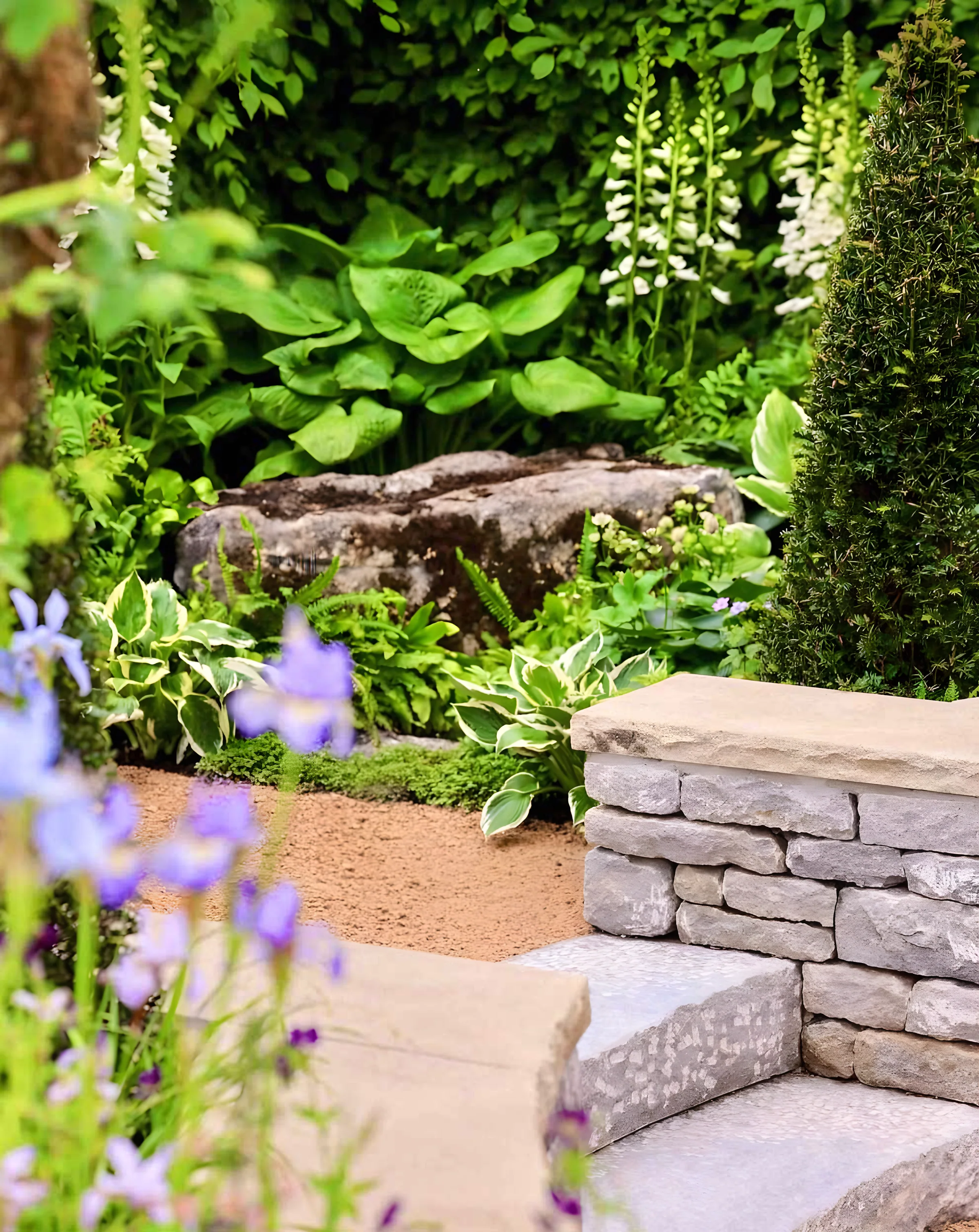
Foxgloves and shade planting against a dry stone wall

Landscape construction

Building on a Hill, on Gravel and Beside a Tidal River

A Richmond terrace is decided by what it sits on before it is decided by the drawing. On the flat ground of Kew, North Sheen and central Richmond the sand and gravel digs easily and drains well, so the care goes into compaction, bedding and edge detail, and into the permeable surfaces and soft landscaping the council asks for, since Policy DM TP 9 asks that impermeable paving is minimised and soft landscaping maximised. On Richmond Hill and the Park fringe the ground is clay that swells and shrinks through the year, sitting on slopes that have already moved, so terraces, steps and retaining walls are built to take that movement rather than to sit on it and crack.

Retaining work on the scarp is what we are asked for most here. The Geologists' Association records the hummocky terrain on the Park side as the result of rotational slips, and the springs that break out at the junction of the gravel with the Claygate Beds end up behind whatever you build. Both of those are design problems before they are construction problems, so a hillside terrace gets real structure, drainage behind the wall and a route for the water to go, not a sleeper stack and a hope. Richmond Hill is also a genuine gradient, which turns a routine materials run into a day's work and makes machine access to a hillside rear garden difficult in its own right.

Excavation on the riverside and at Petersham needs its own caution. The culverted Sudbrook of 1920 to 1922 and an 1890 foul sewer under the A307 Petersham Road collapsed into the Petersham Hole from 1978 through 1979 and closed the road until September 1980, so unknown culverts and ageing services are a real risk when you dig down there. Low lying gardens and paths along Cholmondeley Walk, the lower Petersham Road and Ham Lands go under water around high spring tides because the Thames is tidal below Teddington, so work there is planned to tide windows and nothing is left low overnight.

  • Terraces, steps and levels built for the ground they sit on
  • Retaining walls on the Richmond Hill and Park fringe slopes, designed and drained
  • Spring lines and slope seepage intercepted before they reach the structure
  • Excavation planned around unknown culverts, ageing services and tide windows
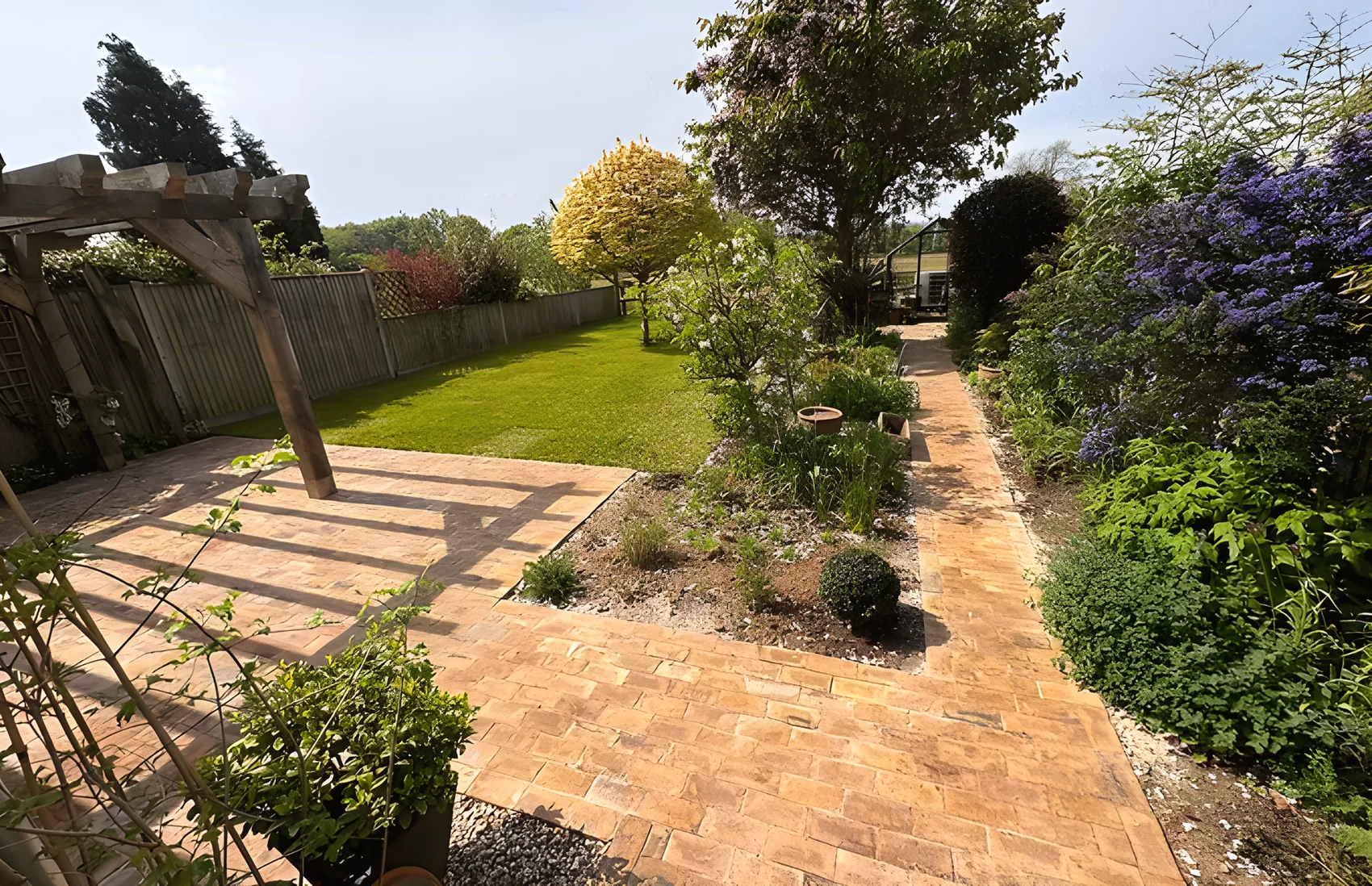
A pergola frame and new planting in a Godalming garden

Water, drainage and soil repair

Three Different Water Problems in One Town

Half of Richmond cannot hold water and the other half cannot get rid of it, which is why one standard drainage detail used across the town is the commonest thing we get asked to put right. On the terrace gravels and brickearth of Kew, North Sheen, Sheen Road and central Richmond the work is to build the soil up, hold moisture at root depth and design zoned irrigation into the construction, so lawns and borders are fed without waste through a dry summer. On the clay and Claygate slopes we deal with the water first and plant second.

Compaction is the other recurring job, and the older villa and terrace plots are where it bites. Decades of builders' traffic down a single narrow access route, over clay subsoil, leave the ground airless and slow to drain. The grass thins, water sits on a surface that looks perfectly sound, and the roots of mature trees begin to suffocate. Deep soil aeration fissures the ground with compressed air to around a metre and holds those fissures open with enriched biochar, around one kilogram per square metre, so it decompacts to depth with no digging at all. That matters more in Richmond than almost anywhere we work, because on most of these plots the lawn sits under protected trees and a machine could not get into the garden anyway.

On the floodplain the brief changes again. From Cholmondeley Walk through Petersham Road to Ham Lands the water table is high and a high spring tide can put a low lying garden under water for an hour or two either side of high water, so levels, fixings, surfaces and planting are chosen there so a tide leaves silt to wash off rather than a rebuild. Plots backing onto the river or the railway also carry an invasive weed risk, which should be surveyed on site rather than assumed, because riverbanks and railway land are general spread routes. We identify and remove knotweed with our specialist invasive weed partners at AIR8, and the order matters, identify first and excavate second.

  • Zoned irrigation built in during construction
  • Deep soil aeration with compressed air and enriched biochar, one treatment
  • Perched water and spring lines intercepted on the hillside gardens
  • Levels and planting that can take a tide on the riverside
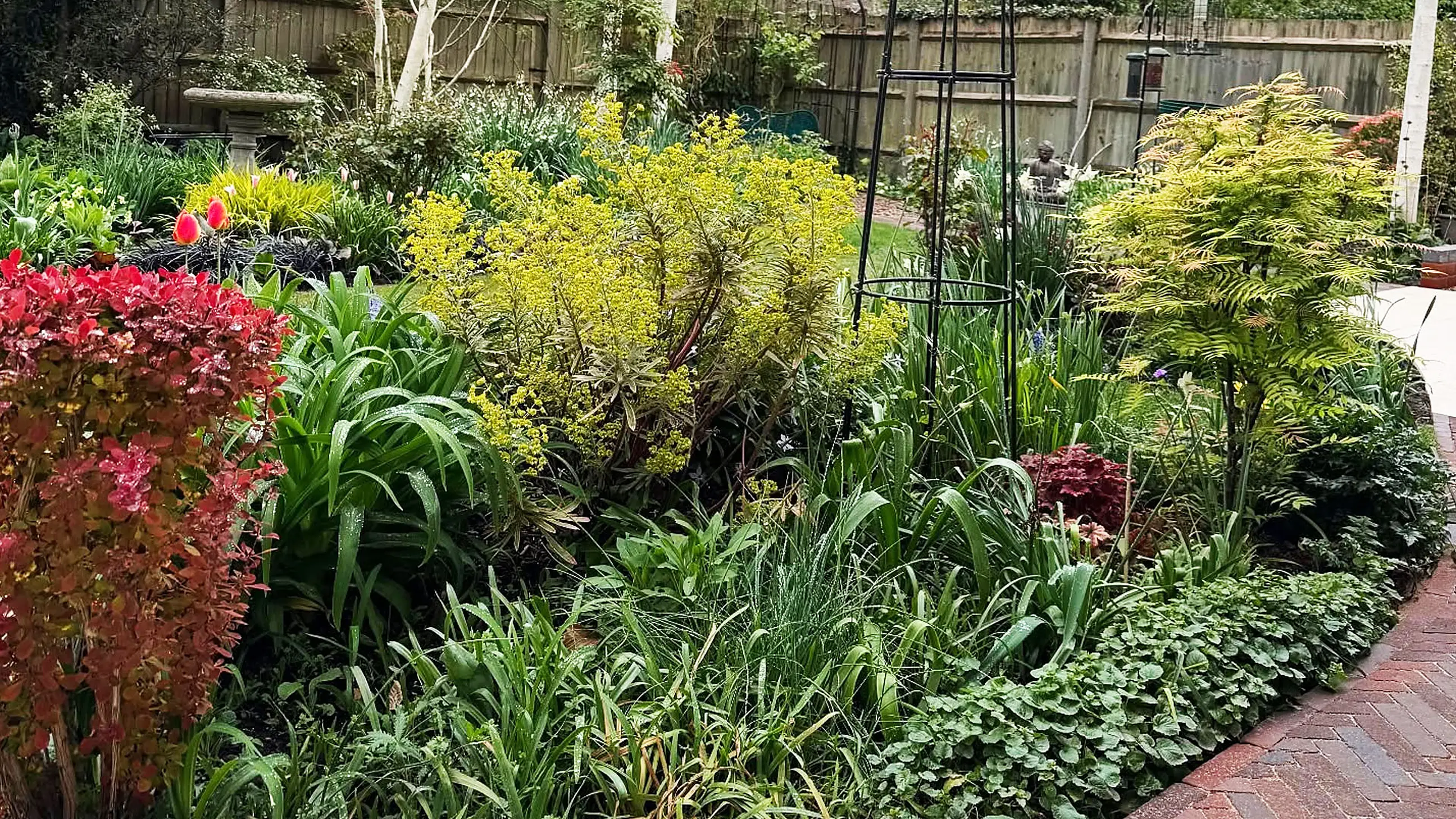
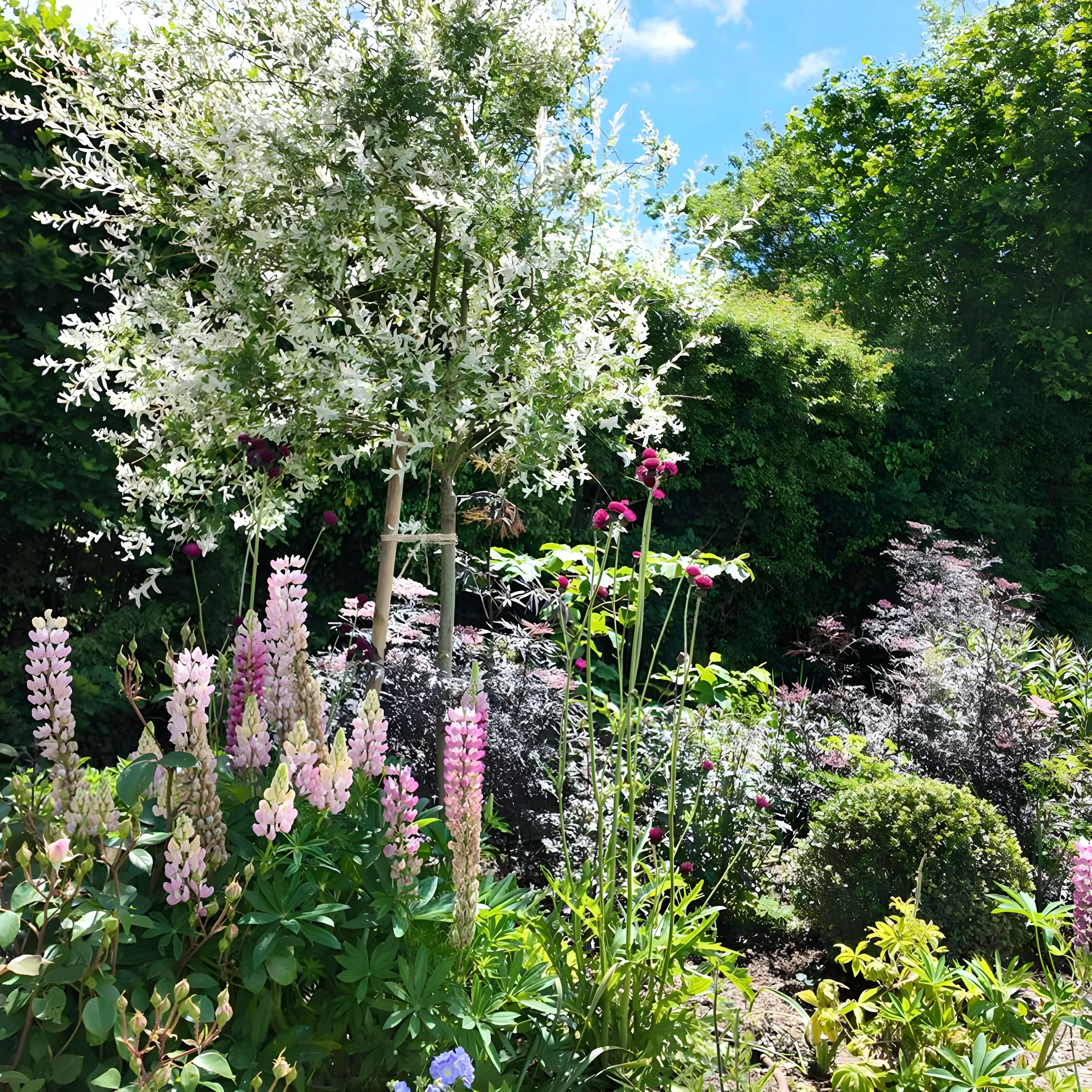
Dense mixed planting running the length of a garden

Planting and long term care

Planting to the Soil You Actually Have

The acid Thames gravel is the defining planting condition across flat Richmond, and it is a gift if you work with it. Ericaceous planting genuinely thrives on it, rhododendron, azalea, camellia, pieris and Japanese maple, and so does dry gravel and Mediterranean planting, lavender, cistus, euphorbia, stipa and bearded iris, with the sharp drainage already there for nothing. What that ground will not do is hold food or water, so organic matter at depth, mulch and irrigation are part of the scheme rather than an afterthought, and new trees, hedges and specimen shrubs need watering through their first two or three seasons.

On the clay and Claygate slopes of Richmond Hill and the Park fringe the palette turns over completely. Roses, hornbeam, yew, viburnum, cornus and hydrangea all do well in ground that is heavy and wet in winter, while anything wanting a dry crown will rot off. The riverside and Petersham gardens on alluvium are fertile and moisture retentive, good for big leaved and damp loving planting but prone to standing water. On the walled courtyard plots behind the Georgian and artisan terraces the whole palette has to work in shade, because high old brick walls and three storey neighbours cut the light, and the council records the rear gardens of Cardigan Road and Montague Road as making a contribution to the street scene and providing greenery, so overlooking is real and screening earns its place.

Then the garden has to be kept, which is the part most schemes lose. The same in house team that designs and builds stays on the garden afterwards, which is how a planting scheme under the limes, planes and chestnuts of an East Sheen or Kew plot reaches maturity instead of being replaced in its third year. Garden maintenance plans start from £160 per month on a twelve month agreement with a minimum four hour visit each month, and the larger grounds at East Sheen, Petersham and Ham and the block estates off Queen's Road run on a planned seasonal calendar rather than a weekly mow. Our work at RHS Chelsea Flower Show 2024 took a Silver Medal, and the same people are in the vans.

  • Planting plans written for acid gravel, for clay or for riverside alluvium
  • Shade planting for the walled courtyard gardens on the terraces
  • Monthly garden maintenance and estate scale grounds care
  • Low impact lighting for paths, steps and planting

On the ground

Where We Work in and Around Richmond

Richmond reads as several places at once. Richmond Hill, Richmond Green and Little Green, Richmond Riverside and central Richmond form the historic core, with The Vineyard and Friars Stile Road just above it, St Matthias on its plateau, and The Alberts, which the council defines as Albert Road, Houblon Road, Albany Terrace, Audley Road, Princes Road and the side roads off them, developed in the 1870s, and the Pagoda Triangle of Pagoda Avenue, Beaumont Avenue and Selwyn Avenue filling the ground towards Kew. Off Sheen Road are Sheendale, Queen's Road, Courtlands, Old Deer Park Gardens and Kew Foot Road, with the Victorian villa streets of Townshend Road, Townshend Terrace, St Mary's Grove, Sydney Road and Dunstable Road north of it.

Beyond that, Kew runs from Kew Green and Kew Gardens through Lawn Crescent and Sandycombe Road, with North Sheen alongside it through North Road, Dancer Road, Darell Road and Niton Road, while East Sheen and Mortlake sit round the northern corner of the Park and Petersham, Ham and Ham Common run south along the river. The green space is a large part of why people pay what they pay here, Richmond Park with the Isabella Plantation and Pen Ponds, the Royal Botanic Gardens at Kew, Old Deer Park, Terrace Gardens and Buccleuch Gardens, Petersham Meadows, East Sheen Common, Ham Common and Ham Lands, and clients ask us to carry that tone over the garden wall.

The town is also cut up for anyone trying to run a working day across it. The Thames severs Richmond from Twickenham except at Richmond Bridge, Twickenham Bridge and the Richmond Lock footbridge, the A205, A305, A307 and A316 all carry heavy through traffic, and the council's own character assessment calls the pocket between the A316 Lower Mortlake Road and the railway, taking in Stanmore Gardens, Raleigh Road, Salisbury Road and Duncan Road, isolated as a result. Controlled parking applies across central Richmond and Kew, so we confirm the zone and book bay suspensions for skips, deliveries and welfare in advance, and on the Courtlands, Queen's Court, Lichfield Court and Gloucester Court estates turning room and standing space are limited, so access is agreed with the management company first. We cover TW9, TW10 and SW14, and we work next door in Barnes, Putney and Wimbledon.

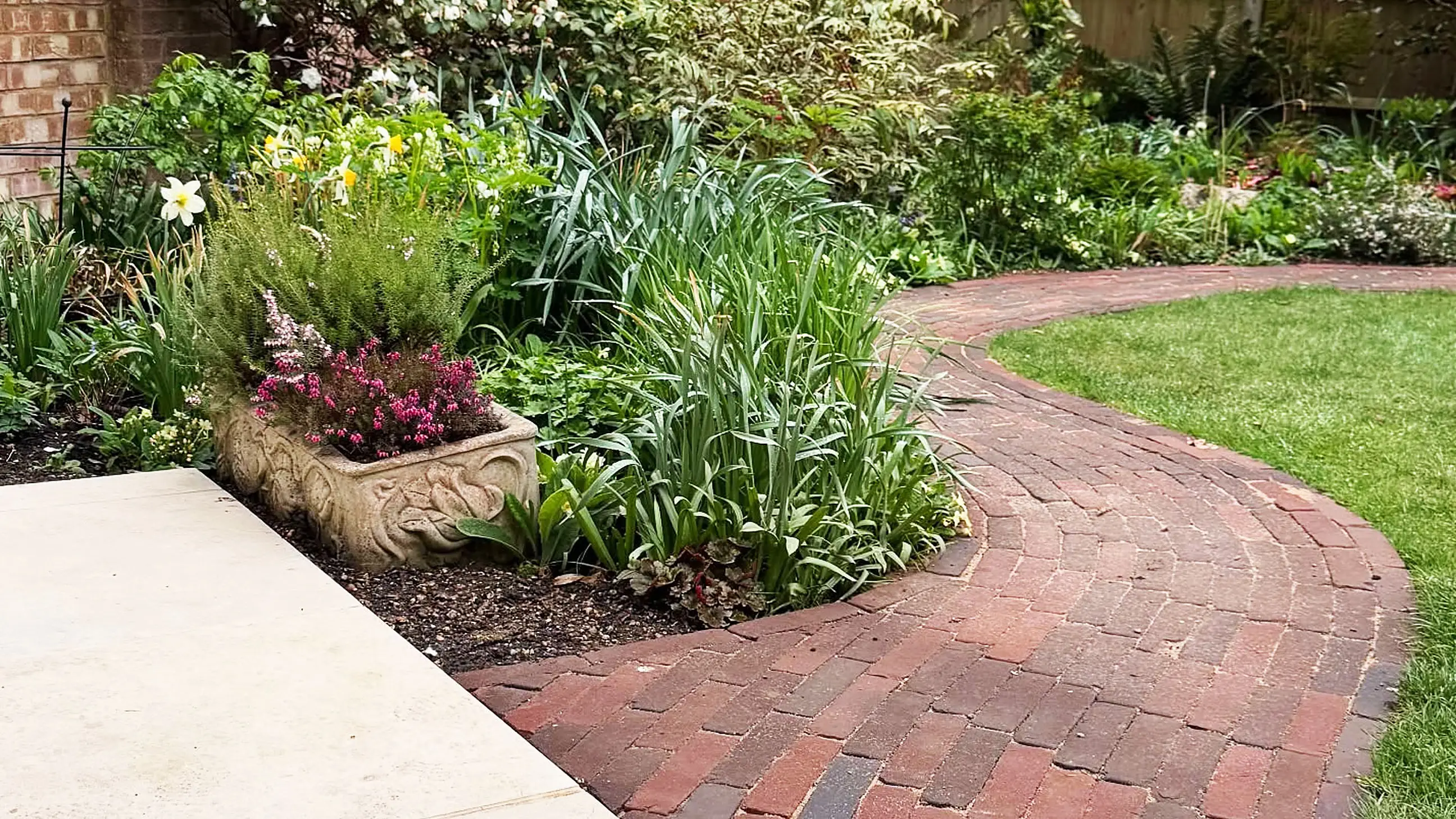
A curving brick path running through deep mixed planting

Neighbourhoods and villages

  • Richmond Hill
  • Richmond Green and Little Green
  • Richmond Riverside
  • Central Richmond
  • The Vineyard
  • St Matthias
  • The Alberts
  • The Pagoda Triangle
  • Friars Stile Road
  • Sheen Road
  • Sheendale
  • Queen's Road
  • Courtlands
  • Old Deer Park Gardens
  • Kew Foot Road
  • North Sheen
  • Kew Green
  • Kew Gardens
  • Lawn Crescent
  • Sandycombe Road
  • East Sheen
  • Mortlake
  • Petersham
  • Ham
  • Ham Common

Postcodes we cover

TW9, TW10, SW14

Planning and trees

Richmond is one of the most heavily designated places in London to build a garden, so the planning position is worth checking at the start of a job rather than at the end. The borough has 85 conservation areas and almost every street a landscaper will work in sits inside one. Trees come first.

Work to a tree in a conservation area generally needs written notice to the council before it starts, and the council says a decision will be reached within a period of six weeks, while its protected trees guidance generally expects a tree work application for a protected tree above a small stem size. Tree preservation orders in the borough run from single trees to whole woodlands, applications take up to eight weeks to be processed, and the council advises taking professional arboricultural advice. Exemptions for dead or dangerous trees exist, but the council still expects at least five days written notice where there is an imminent safety risk, and at least five working days written notice for a dead tree, so a notice period generally has to sit in the programme rather than be discovered part way through it.

Back gardens have their own protection here. Development Management Plan Policy DM HO 3 on backland development states there will be a presumption against loss of back gardens due to the need to maintain local character, amenity space and biodiversity, and requires that trees, shrubs and wildlife habitats important to character, appearance or wildlife must be retained or re provided, so garden rooms, studios and larger outbuildings are worth thinking about early, and the landscape design and the planning case are usually best made together. Front gardens are handled tightly too.

Policy DM TP 9 on forecourt parking discourages the parking of vehicles in existing front gardens, especially where it would result in the removal of architectural features such as walls, gates and railings, or of trees and other vegetation, and the council asks that impermeable paving is minimised and soft landscaping maximised, which is also why it is unwise to assume a frontage can simply be widened to get plant in. On top of that, Article 4 Directions are in force on named groups and whole streets, and the council's own summary of what those directions remove covers replacing front gardens and replacing boundary walls with hard surfaces, as well as extensions and additions, new doors and windows, painting and rendering brickwork and removing chimneys. The Article 4 streets that matter for garden work here include Mount Ararat Road, The Vineyard, Dynevor Road, Houblon Road, Albany Terrace, Montague Road and Rosemont Road in St Matthias, Halford Road and St James's Cottages in central Richmond, Old Palace Lane and Park Road on the riverside, Dunstable Road, St Mary's Grove, Sydney Road, Townshend Road and Townshend Terrace off Sheen Road, Lower Mortlake Road and Shaftesbury Road, Lawn Crescent, Elizabeth Cottages and Victoria Cottages in Kew, The Green, Gloucester Road, Priory Road and Cambridge Cottages at Kew Green, Ham Street, Wiggins Lane and Ham Gate Avenue in Ham, Petersham, The Mall in East Sheen, Model Cottages, and Lodge Avenue, Queen's Road and South Worple Way in Mortlake.

Then there is the view protection, which is unusual even here. The Richmond, Petersham and Ham Open Spaces Act 1902 prevents development of the land on and below Richmond Hill in order to protect the views to the west and south, and the council's objectives include protecting the views from Richmond Hill and Richmond Park, maintaining the skyline and ridgeline and ensuring St Matthias remains the dominant feature, together with the views to the Pagoda in the Kew Gardens World Heritage Site and the protection of its buffer zone, while Richmond Park holds the protected vista of St Paul's from King Henry's Mound. Richmond Park itself is a Site of Special Scientific Interest, notified in 1992 for its diverse deadwood beetle fauna associated with the ancient trees and because it supports the most extensive area of dry acid grassland in Greater London.

Old Deer Park is Grade I on the register of Historic Parks and Gardens and has Metropolitan Open Land status over most of its area, with the Grade I listed Kew Observatory inside it. The Royal Botanic Gardens are Grade I on the register and have been a UNESCO World Heritage Site since 2003, with a buffer zone, the Terrace Walk on Richmond Hill is registered Grade II star, with Terrace Gardens and Buccleuch Gardens Grade II, and much of the riverside falls inside Metropolitan Open Land and the Thames Policy Area under Policy DM OS 11. Finally, a very large number of houses here are listed or designated Buildings of Townscape Merit, the latter locally listed rather than nationally designated, and the walls, gates, railings and paving in front of them are often part of what is protected, so a boundary or hard landscaping change on one of those plots may need consent in its own right.

None of the above is legal advice, and we would always rather check a position with the council before the machines arrive than afterwards.


Recent work

Gardens We Have Designed and Built

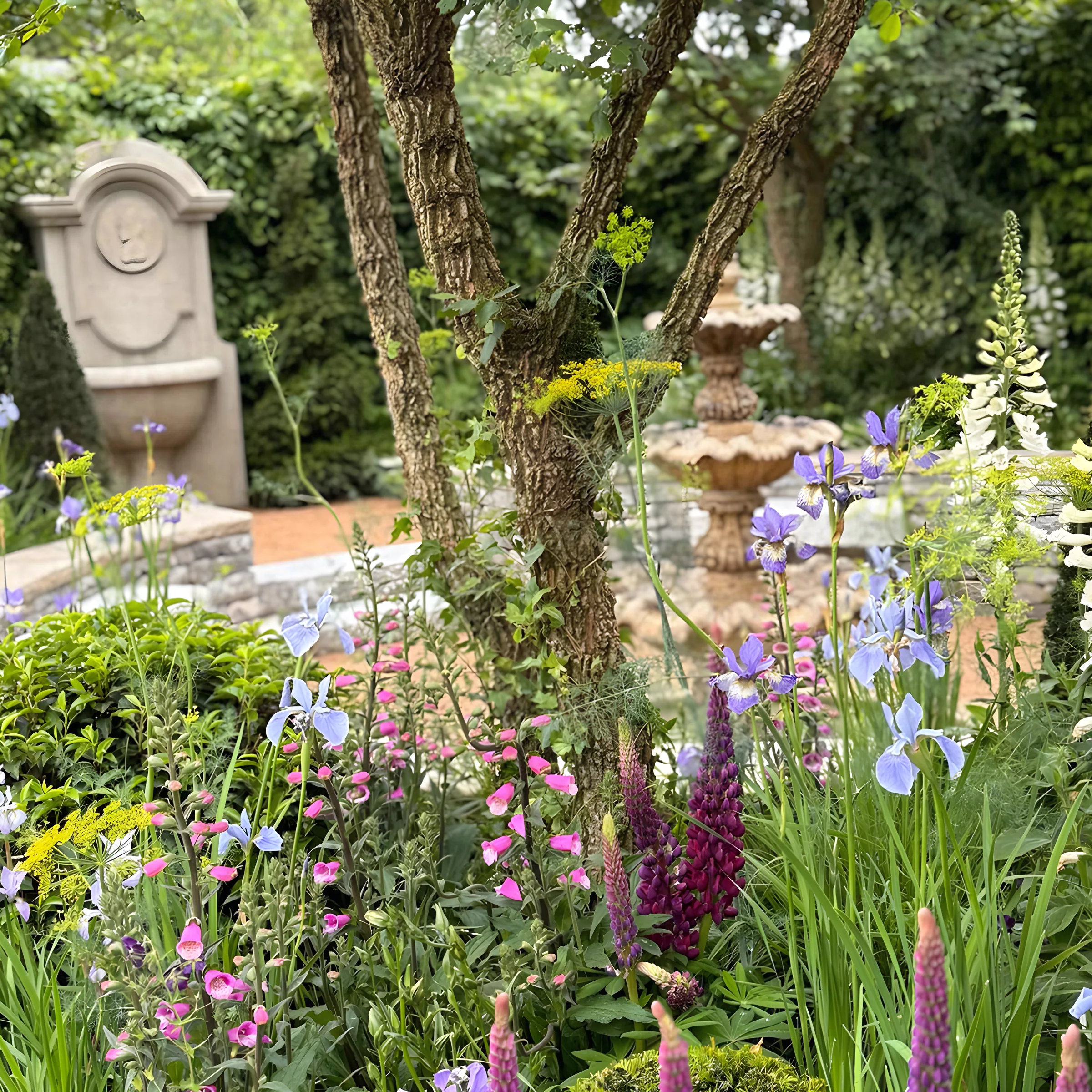
  • Cottage garden borders in full flower around a stone water feature
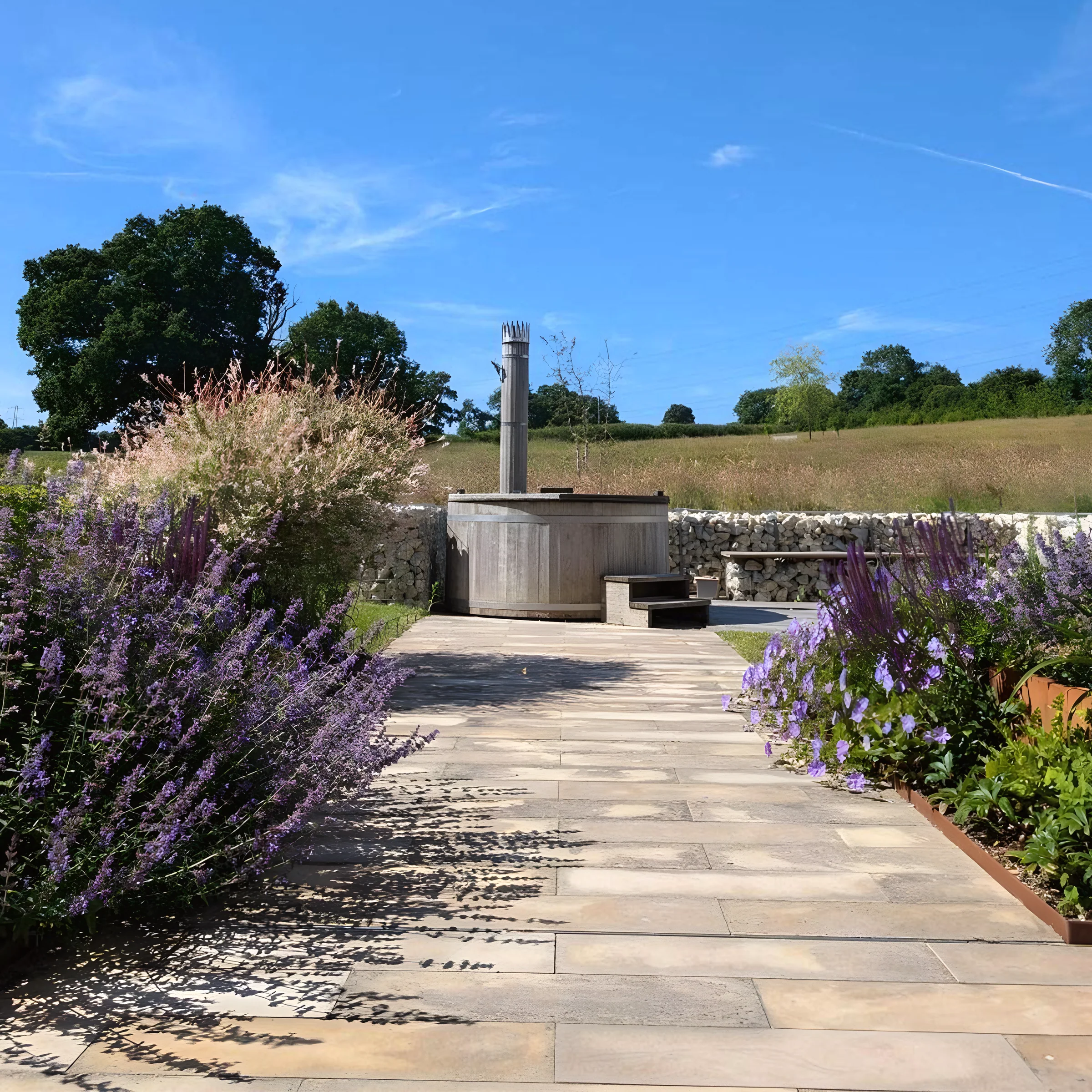
  • Lavender in flower along a stone path
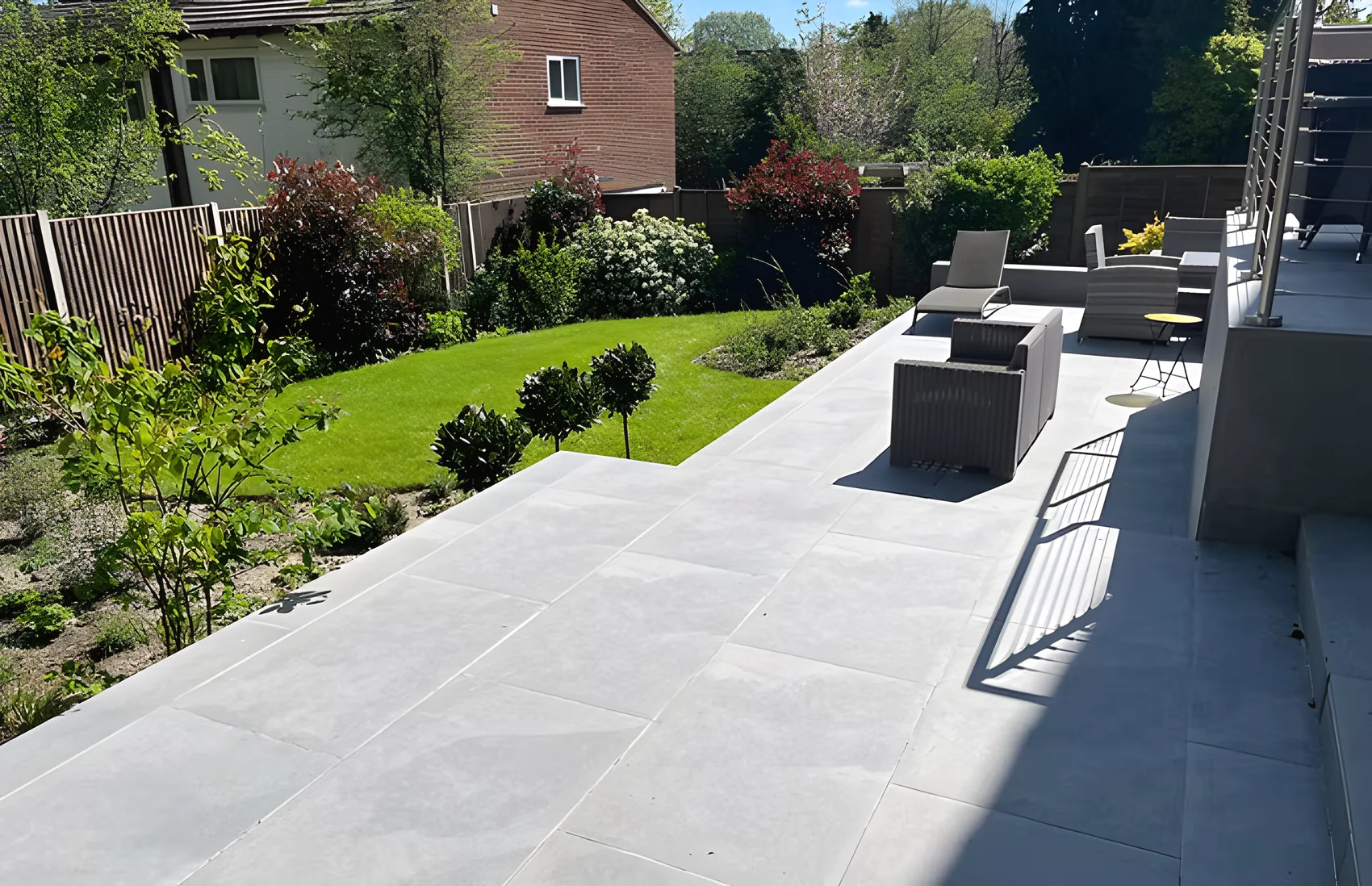
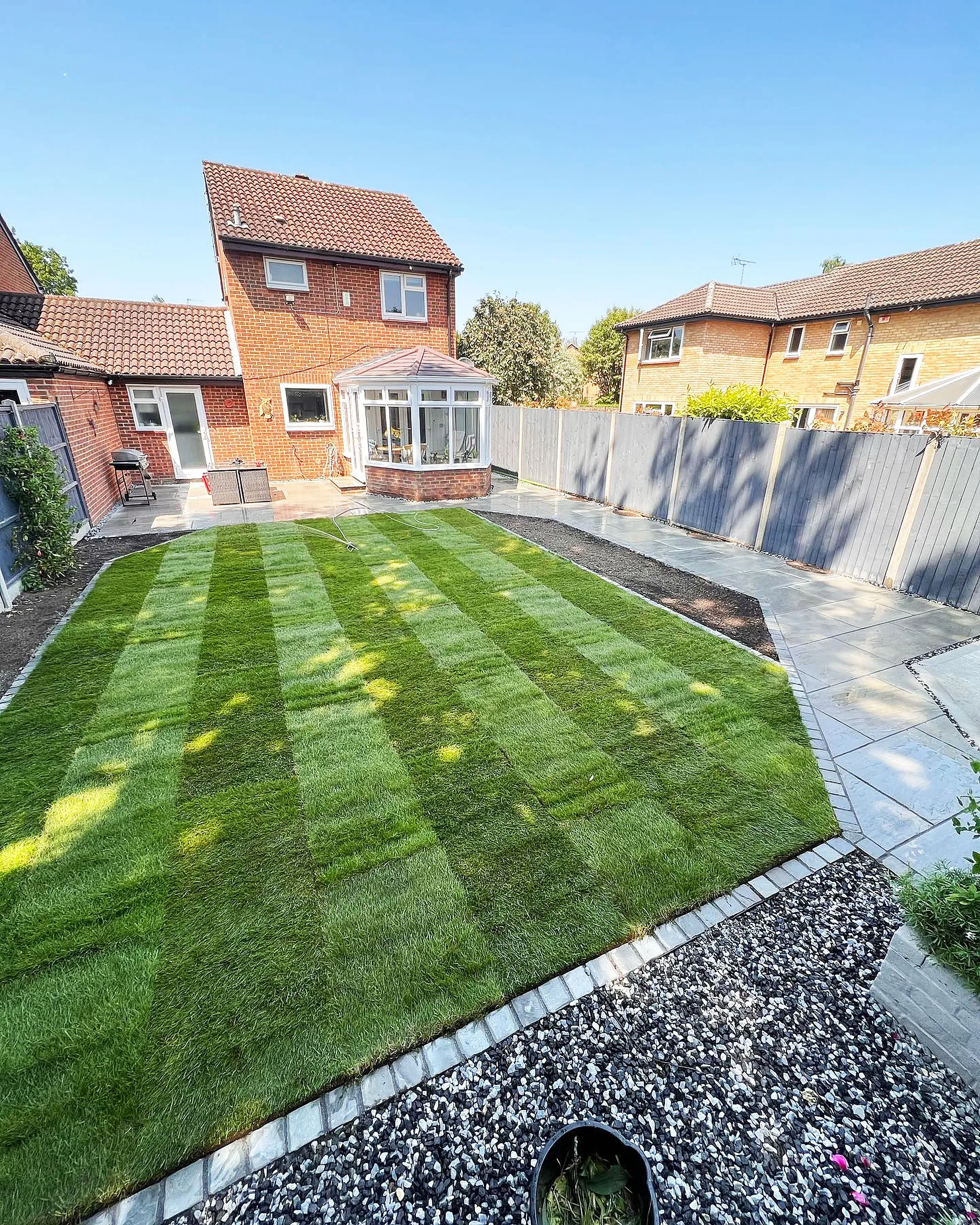
  • Stone paving laid in long bands beside a lawn

Good to know

Richmond Garden Questions, Answered

Is My Richmond Garden on Gravel or on Clay?

It depends how high up you are, and it is worth knowing before anything is specified. Central Richmond, the Green, Old Deer Park, Kew and North Sheen sit on lower Thames river terrace sand and gravel with wider patches of brickearth, which is free draining and acid. Climb Richmond Hill and you are on the silty Claygate Beds at the top of the London Clay, which is heavy, wet in winter and shrink swell in summer, and along the river you are on alluvium with a high water table under it. We test the soil on the first visit rather than reading it off a map, because Richmond genuinely has all three.

Why Does My Lawn Burn Off Every July?

Because the ground under it almost certainly cannot hold water. The terrace gravels and brickearth across Kew, North Sheen, Sheen Road and much of central Richmond are free draining, so summer moisture is gone and the nutrients leach away with the winter rain that follows. New trees, hedges and specimen shrubs sulk on that ground without irrigation through their first two or three seasons, and a lawn laid straight onto it will scorch every year whatever you feed it. The answer is to build the soil up at depth, mulch properly and design zoned irrigation in during construction rather than add it afterwards.

There Is a Wet Patch Half Way Down Our Garden on Richmond Hill. Is It a Leak?

Usually not. Where the gravel cap sits on clay, water perches and breaks out as springs and small streamlets at the junction of the gravel with the Claygate Beds, and the result is ground that stays wet whatever the weather. It gets misread as a burst pipe or a failed land drain, and digging up a perfectly sound pipe does not cure it. The fix is to intercept the water above the wet band, take it somewhere useful, and plant the band itself for the conditions it actually has.

Do I Need Permission to Cut Back the Trees in Our Garden?

Quite possibly, and in Richmond it is the first thing to check. Work to a tree in a conservation area generally needs written notice to the council before it starts, and the council says a decision will be reached within a period of six weeks, while its protected trees guidance generally expects a tree work application for a protected tree above a small stem size. Tree preservation orders here run from single trees to whole woodlands, applications take up to eight weeks to be processed, and the council advises taking professional arboricultural advice. Since almost every street a landscaper works in sits inside one of the borough's conservation areas, we assume a significant tree is protected until that position has been checked, and we build the notice period into the programme rather than into an apology.

There Is No Way Into Our Garden Except Through the House. Can You Still Build It?

Yes, and it is a large part of what we do in Richmond. The Georgian terraces around the Green and the tight two storey terraces of The Alberts, the Pagoda Triangle, Alexandra Road and Windsor Road in Kew and the North Sheen streets have no rear access whatsoever, and in several of those streets the front gardens are too small to park on in the first place. Those jobs run on small dumpers, barrows and hand balling with the house properly protected, and the narrow lanes of the historic core, Old Palace Lane, Friars Lane, Water Lane and Albany Passage, rule out grab lorries and large plant altogether. What access really decides is the size of plant, unit and tree that can physically be installed and what it costs to get the spoil out, so we would rather tell you that at the quote than find it on the first morning.

We Want a Garden Room at the End of the Plot. Is That Straightforward Here?

It needs thinking about early rather than assuming. Development Management Plan Policy DM HO 3 on backland development states there will be a presumption against loss of back gardens due to the need to maintain local character, amenity space and biodiversity, and it requires that trees, shrubs and wildlife habitats important to character, appearance or wildlife are retained or re provided. On the larger plots at East Sheen, Kew and the Park fringe there is a second question, because the council records a notable lack of infill between the buildings resulting in continuity of the landscape throughout the area, so what goes at the end of your garden is read from several others. We would rather draw the landscape and make the planning case together than design something lovely and then go looking for consent for it.

Close by

We Also Work In

Start your garden

Talk to Us About Your Garden in Richmond

Tell us where the garden is and what you want from it, and we will come and look at the ground. We design, build and then look after the garden with the same in house team, so the person who set the levels is the one who watches the planting mature. Call 01276 582095 or 07717 058646, or email info@cjlandscapesltd.co.uk. We work right across Richmond, TW9, TW10 and SW14, and next door in Barnes, Putney and Wimbledon.

  1. 01
    We Call You BackWithin one working day, to talk the garden through.
  2. 02
    The First VisitA walk round the garden to take in the levels, the access and where the water sits.
  3. 03
    A Written ScopeA specification and a programme, with samples to see in your own light.
Prefer to talk?01276 582095info@cjlandscapesltd.co.uk
1 Webbs Mews, High Street
Hartley Wintney, Hook RG27 8NZ
What Would You Like Help With?

Choose as many as you like.

Tell Us About the Project

Roughly is fine. It helps us bring the right people to the first visit.

Your Details
Photographs Optional, up to five

Thank You

Your enquiry has come through and we will call you back within one working day.

Step 1 of 3

We only use your details to reply to this enquiry.