C J LANDSCAPES Get in touch

Virginia Water, Surrey

Landscaping in Virginia Water Sand on Top, Clay Underneath.

Design, construction and maintenance for gardens on Bagshot sand, from the woodland plots of the Wentworth Estate to the regular back gardens at Trumps Green.

Virginia Water, Surrey

A Wooded Village on Free Draining Sand and Almost None of It Behaves the Same.

Virginia Water is small, wooded and very quiet, sitting in the north west part of Runnymede with Windsor Great Park and its lake along one side and the lowland heath of Chobham Common off to the south west. It does not read as a town and it barely reads as a village. Residents said as much in their own consultation, that there is no central heart or meeting place, and that the lake is the thing they think of as the middle of it.

We work across this corner of Surrey from our base in Hartley Wintney, and Virginia Water is the one place where who owns the road matters as much as what the garden needs. The Wentworth Estate runs its own private roads under its own committee, with its own covenants, its own security and its own verges and ditches to protect. Away from the Estate the village is far more ordinary than its reputation suggests: post war semis and bungalows at Trumps Green, gated conversions at Virginia Park and St Ann's Park, and a ribbon of old farm cottages running out along Stroude Road.

What ties the whole place together is the sand. Virginia Water sits on the Bagshot Formation, and that single fact explains most of the garden problems here. Lawns go off colour early. New planting dies in its first August. Feed and compost wash straight through. And then, in the same garden, there is a corner at the bottom that never dries out. Read that properly and everything else follows. Read it wrong and you are rebuilding.

See the work
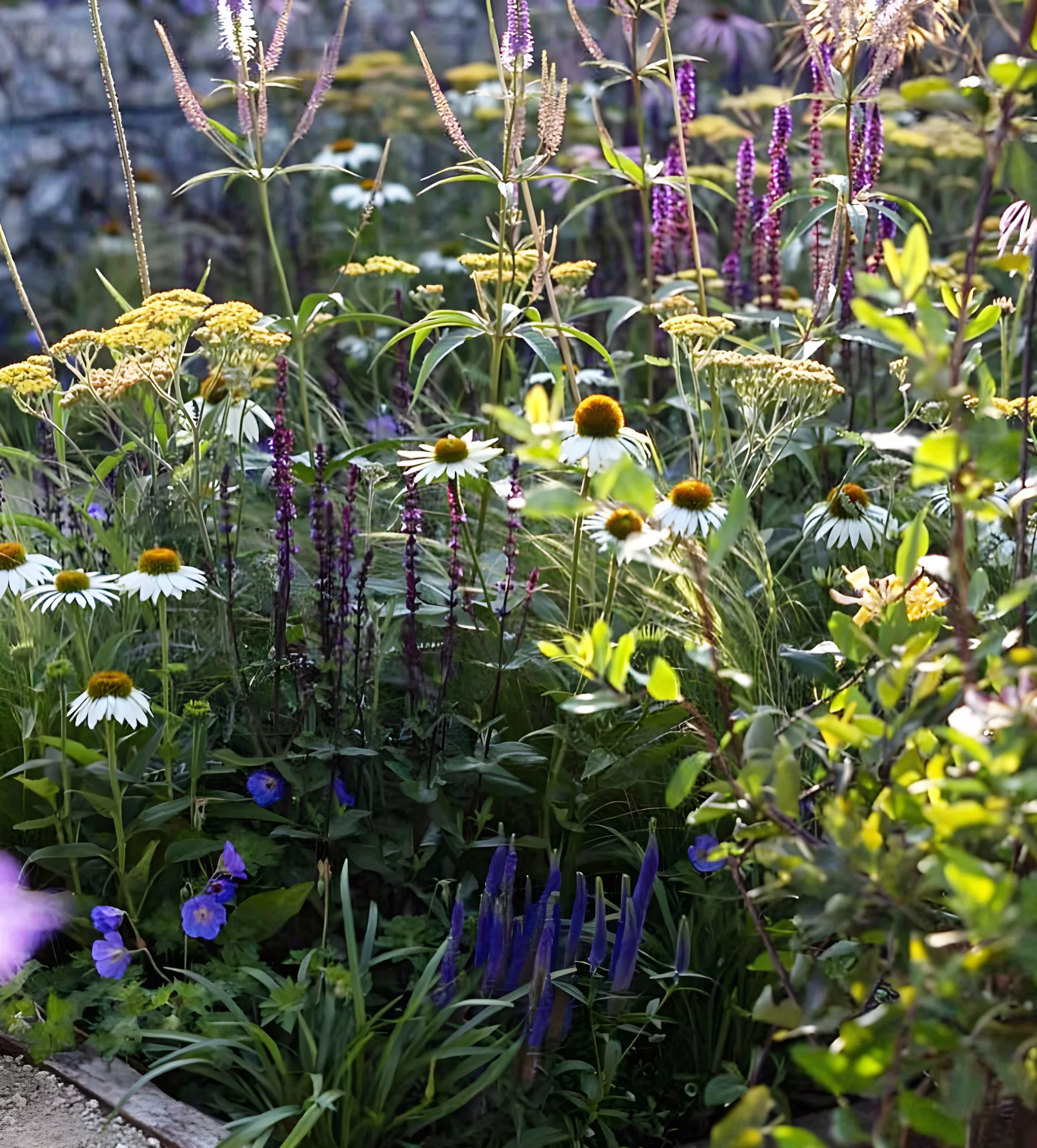
Echinacea and mixed perennials in a naturalistic border

The houses

No Single Kind of Plot Inside One Small Village.

There is no single Virginia Water house. Inside one small village you can price a woodland plot on the Wentworth Estate where the garden is read against a golf course, a post war semi at Trumps Green with a rectangular back garden and a side gate, and a town house inside a Grade I listed former sanatorium behind its own walls and gates. Each of those is a different build before anyone has looked at a drawing.

What they share is tree cover and open boundaries. Across the Wentworth Estate the original covenants kept hard walls and panel fencing out, which is why those roads read as continuous parkland rather than a street of houses, and the Neighbourhood Plan treats that open boundary character as important for wildlife moving through. It also means a boundary here has to be grown rather than built. Establishing an evergreen or beech hedge on dry sand under pine and oak is a structural job with its own soil preparation and its own irrigation, not a line of plants at the end of a project.

The last piece is the rural edge. Callow Hill and the northern side of Christchurch Road are Crown Estate land, historically owned and farmed by the Crown, where the priority is keeping the parkland setting, so gardens there read as clearings in a wider landscape and the Design Code asks for the frontage trees and hedgerows to stay. Stroude Road and Sandhills Lane are a century of linear development on very regular plots, ground that was smallholding, nursery and farm and has been converted piecemeal ever since, some of it without proper consent. We survey before we price a build on that side of the village, because buried hardcore and made ground are the normal finding there rather than the surprise.

  1. 1920s and 1930s Tarrant originals, since largely replaced by neoclassical mansions
    Very Large Detached House on a Woodland Plot, Wentworth West, Known Locally as the IslandPortnall Drive, Portnall Rise, Portnall Road, Wentworth Drive, and East, West, North and South Drive

    Plots counted in acres, set inside woodland, so most of the houses and most of the gardens are hidden by the tree cover and the long views are closed off by it, which the Design Code asks new work to respect. The houses are large enough that some basements run wider than the ground floor above them, so the usable garden often begins well back from the building, behind retaining ground and light wells. Wide grass verges, substantial entrance gates and hedged boundaries with no hard walls or fencing give the whole area the look of low density parkland against the three championship courses at Wentworth Club, and every load still comes in over a private road, a verge and a roadside ditch. Wentworth West is Green Belt.

  2. 1920s to 1960s original build, with the Tarrant houses now rare and mostly replaced by Georgian style brick
    Large Detached House on a Smaller Estate Plot, Wentworth EastWellington Avenue, Gorse Hill Road and Gorse Hill Lane, Monks Road, Nuns Walk, Abbey Road, Friars Road, Virginia Drive, Woodlands Road with its east and west arms, and Christchurch Road down to the retail parades

    The same green, open character as The Island but tighter, on plots a good deal smaller than the ones over there. Houses are smaller too and basements are uncommon, which leaves more of the plot as garden. There are no hard boundary walls or panel fences here either, so boundaries are evergreen or beech hedging and post and wire, and strong common building lines keep the front gardens shallow and consistent, which puts most of the visual work on the frontage planting. Mature pine and oak stand behind almost every plot, so the beds along the boundaries deal with dry shade and heavy root competition. Unlike Wentworth West, Wentworth East sits outside the Green Belt.

  3. An 1885 sanatorium, closed in 1980 and converted from 1994, with new build laid out in the grounds
    Gated Estate House, Converted Town House and ApartmentVirginia Park with Holloway Drive and Pinel Close off Stroude Road, and St Ann's Park off Sandhills Lane on the north side of Stroude Road

    Virginia Park is the former Holloway Sanatorium, Grade I listed with a separately Grade II* listed former chapel, converted into town houses inside the main building with new houses and apartments laid out around it, all behind walls and gates. The residents association collects service charges under the title covenants and maintains the land, gardens and communal areas including the main listed building, so a private scheme has to sit inside a wider managed landscape rather than ignore it, and these gardens are overlooked by the listed building and its tower. St Ann's Park is a separate gated community on the north side of Stroude Road, governed by title covenants and a management committee responsible for the grounds, the roads and any alteration to a house. The decorated brick walls of the old sanatorium campus line Stroude Road and Christchurch Road, and the Design Code asks for them to be kept.

  4. Post war, the 1950s and 1960s, with pockets of 1930s
    Two Storey Detached and Semi Detached Family House, Chalet Bungalow and Dormer BungalowTrumps Green Road, Trumps Green Avenue and Close, Cabrera Avenue and Close, Harpesford Avenue, Sundon Crescent, Crown Road, Crown Lane, Knowle Grove and Knowle Grove Close, Beechmont Avenue, Bourne Road, Furnival Close, Trotsworth Avenue and Morella Close

    Brick and rendered houses with pitched tiled roofs on uniform plots with strong building lines on every road, which makes these the most regular gardens in the village: rectangular, fenced, much the same width, back to back. The real asset is the tree cover, and the Design Code asks for it to be protected. That covers the clusters in the rear gardens of Trumps Green Avenue backing onto Trumps Green Road and Crown Road, the clusters between Trumps Green Road and Knowle Grove Close and between Crown Lane and Furnival Close, the ancient woodland between the two parts of Knowle Grove, and the mature trees around the King George V Playing Field. Plots run downhill in places as Trumps Green Road winds up towards Longcross, and the Bourne River Nature Reserve sits immediately behind the Cabrera Avenue gardens, so the lowest gardens are the damp ones. Rear access is usually a side gate and nothing more.

The ground

Bagshot Sand Over London Clay and a Spring Line in Between.

Virginia Water sits on the Bagshot Formation, which the geological survey maps here as its own outlier: fine, pale, quartzose sand that water runs straight through. Underneath the whole sequence is London Clay, and the gardens that puzzle their owners are the ones sitting on the join.

RAINTopsoil and turfBagshot Formation sandClay lenses inside the sandLondon Clay Formationwater stops here

Layer 1

Thin, Acid Topsoil

There is not much of it and it holds very little. This is strongly acid, low nutrient ground, so compost, leaf mould and well rotted bark worked into the top layer every year is not a finishing touch here, it is the whole job. Without it, feed and water are past the roots before the plant has had either.

Layer 2

Bagshot Sand

Fine, pale sand with visible planar and cross bedding, permeable all the way down. It is free draining to a fault. The ridge through the Wentworth Estate and Knowle Hill bakes hard in a dry summer and lawns there go off colour sooner than gardens on the Thames side do, so new planting needs water through its first summers. That is why we put irrigation in while the garden is being built rather than fit it afterwards.

Layer 3

Clay Lenses and the Pebble Bed

Thin beds and pockets of pale grey clay occur sporadically inside the sand, and an impersistent bed of rounded black flint pebbles has been proved at the base of it around Virginia Water. Those are what throw perched water and spring lines, so one plot can hold a parched front lawn and a boggy bottom corner with nothing wrong with either. Working out which is which before levels are set is the difference between a terrace that works and one that sits in a puddle.

Layer 4

London Clay Underneath

The whole sequence rests on London Clay, with river terrace gravels capping the higher ground, head deposits of sand, clay and gravel washing down the lower slopes, and the Windlesham Formation coming over the top eastwards towards St Ann's Heath and the Stroude Valley. For a garden that means a soakaway has to be proved at depth rather than assumed, because sand over clay only drains as far as the clay.

We are extremely happy with the work that CJ Landscapes carried out for us and have now used them several times.

Jonny Franks · Google review

The RHS Silver Gilt medal card from Hampton Court Palace Garden Festival 2023

Landscape construction

Getting a Build Onto a Wentworth Plot

The Estate roads are private, maintained and policed by the Wentworth Estate Roads Committee under the Wentworth Estate Act, and its guidance is that an owner enters a Deed of Agreement with the Committee before any work starts on site, with a meeting arranged between the owner or their professional advisors, the appointed contractor, a representative of the Committee and a representative from the security company. Plant, deliveries and skips are therefore arranged with the Estate, not just with the client.

New or relocated driveways across the wide grass verges have to be built to a specification the Committee has approved, and the roadside ditches that drain the private roads and verges must not be blocked or reduced in section, with a culvert of adequate size where a drive crosses one. A machine track over a verge is not a free decision here.

Virginia Park and St Ann's Park are their own gated communities with their own committees controlling access and alterations, so vehicle size, working hours and the route in are all agreed before we start. The one hard physical limit in the village is the height restriction on the railway bridge at Trumps Green Road, which keeps tippers, grab lorries and low loaders coming from the Longcross side out, so they route round rather than through.

  • A Deed of Agreement and a site meeting before work starts on the Estate
  • Verge and ditch crossings kept to what the Committee has already approved
  • Roadside ditches left open, with a culvert where a drive crosses one
  • Crew vehicles parked off the Station Approach parade on village centre jobs
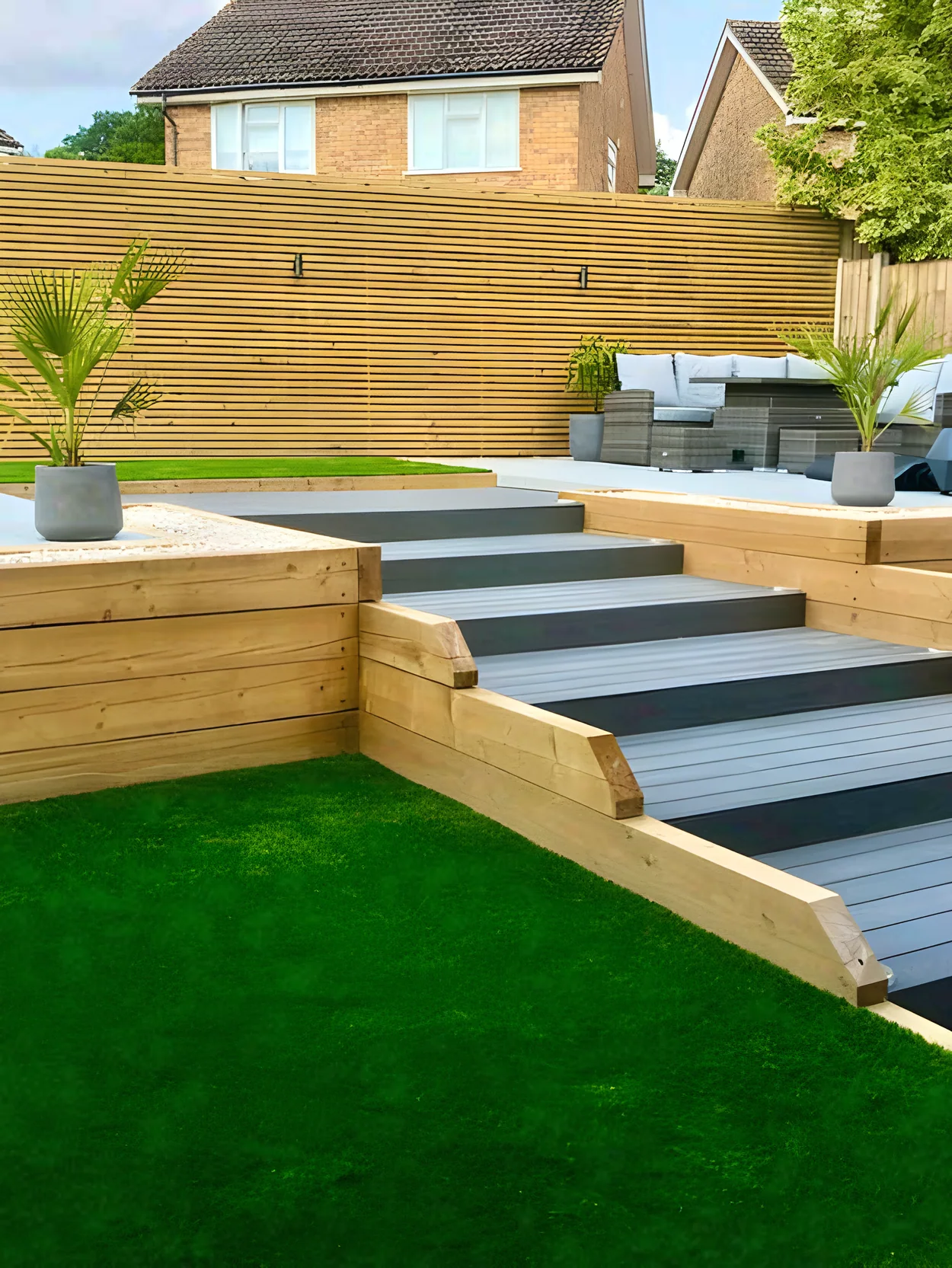
A tiered deck and lawn stepping down through a sloping garden

Deep soil aeration

Why the Lawns Here Give Up in August

Two things are usually happening at once. The sand holds almost nothing, so a lawn on the ridge runs out of water and feed before the rest of Surrey does. Underneath that there is compaction. The Wentworth plots have been rebuilt again and again, with few of the original Tarrant houses left and larger houses with substantial basements in their place, and the ground has carried every one of those builds. Long gravel and tarmac drives and lawns that have taken construction traffic show the same thing.

Decompaction to depth is often the precondition for anything else working. We use compressed air to open fissures right through the profile without digging, then hold them open with enriched biochar, which also gives the sand something to hold moisture and nutrients against in the root zone. One treatment, and it does not need doing again.

After that a lawn here still needs feeding and watering to stay presentable through August, and in the woodland plots it needs light as well, which is usually the harder thing to find. Where the shade is permanent we would rather say so and plant it properly than sell you the same turf twice.

  • Compressed air decompaction through the profile with no excavation
  • Enriched biochar holding the fissures open and the moisture in
  • Zoned irrigation built in while the garden is under construction
  • A straight answer where a lawn will not hold under mature pine
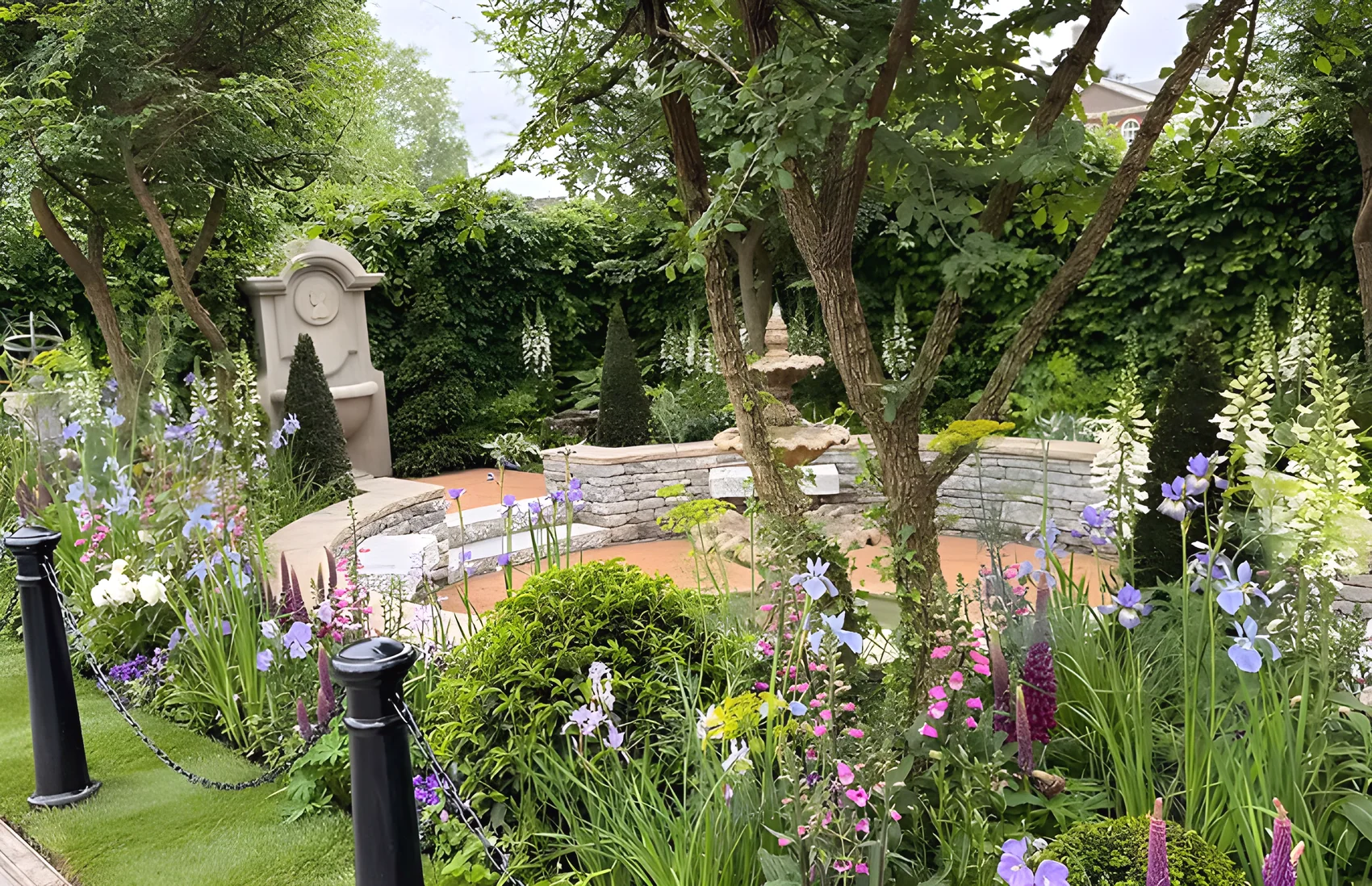
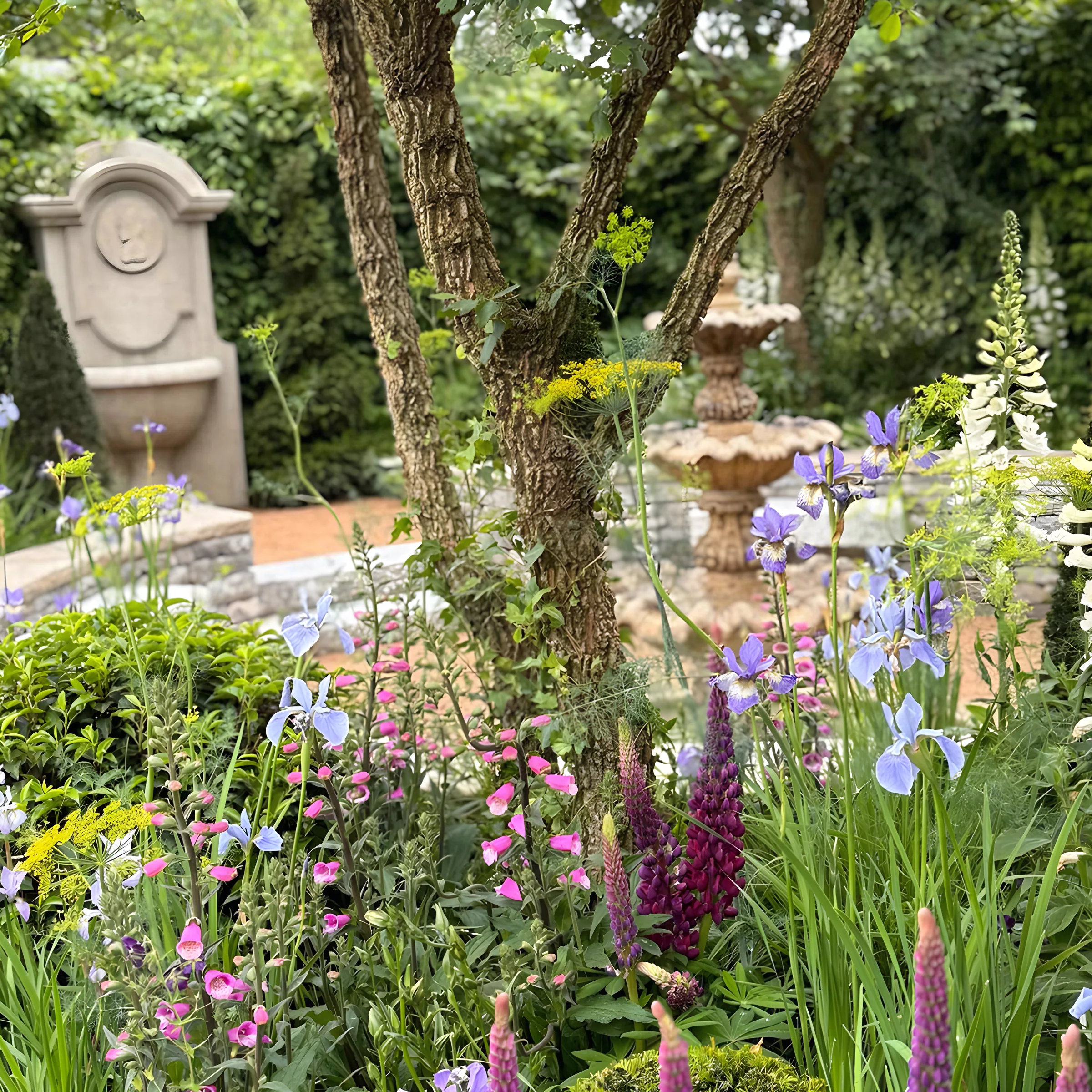
Mature trees and layered planting in the RHS Chelsea 2022 show garden

Garden planting

The Planting This Ground Actually Wants

Strongly acid sand is a gift if you plant with it rather than against it. The proof is on the far side of the lake. The Valley Gardens, on the northern shore of Virginia Water, hold national collections of magnolia, rhododendron and Glenn Dale azaleas along with Himalayan and Chinese birches, on this same ground. Rhododendron, azalea, camellia, pieris, magnolia, heather, Scots pine, birch and oak all do well here without being coaxed.

What sulks is anything wanting lime, or a sweet, moisture retentive loam. Most roses, a classic herbaceous border and any kind of kitchen garden have to be built here rather than planted, which means a made soil, raised where it needs to be, and a feeding programme that keeps it that way. On the damp side of the village, along the Bourne at Trumps Green and behind Cabrera Avenue, the problem flips: lawns stay soft into late spring and timber in contact with the ground has a short life, so we detail it differently.

There is also browsing to design around. Deer are resident in the Cabrera woodland and residents report badgers, foxes and hedgehogs across the area, and the open Estate boundaries exist partly so that wildlife can move through. So new planting goes in with protection, boundaries are closed with the evergreen or beech hedging the Estate character depends on rather than a panel, and the species list treats browsing pressure as a given rather than a disappointment.

  • An ericaceous palette that suits the ground instead of fighting it
  • Made soil and raised ground where lime lovers are wanted
  • Hedge establishment treated as structure, with irrigation behind it
  • New planting protected against deer from the day it goes in

On the ground

Where We Work in Virginia Water

The Wentworth Estate is the dominant piece of the village, and it is really two places. Wentworth West, known locally as The Island, is the woodland plots along Portnall Drive, Portnall Rise, Portnall Road, Wentworth Drive and the four Drives, and it lies in the Green Belt. Wentworth East is tighter and outside the Green Belt, running along Wellington Avenue, Gorse Hill Road, Monks Road, Nuns Walk, Abbey Road, Friars Road, Virginia Drive and Woodlands Road down towards Christchurch Road and the parades.

North and east of there we work at Virginia Water Centre around the station, at St Ann's Heath, and in the two gated estates at Virginia Park and St Ann's Park off Stroude Road, with Sandhills Court and The Orchard nearby. Trumps Green is the other half of the village, with Knowle Hill on the ridge above it and the Bourne running through the Cabrera Trust woodland at the bottom of the Cabrera Avenue gardens. Trotsworth, Trotsworth Avenue and Morella Close fall inside the Wentworth East design code area but are exceptions to the Estate guidelines, with highways managed by Surrey County Council rather than the Estate Roads Committee and residents exempt from the Estate road rates, though title restrictions such as one house per plot still apply.

Out along the Stroude Valley the village thins into Stroude itself, with Thorpe Green, Thorpe, Egham and Englefield Green beyond it, and Lyne, Longcross, Chertsey and Hurst Lane around the edges. Callow Hill and the Crown Estate land hold the separation between Virginia Water, Englefield Green and Egham. Sunningdale and Ascot are just over the Berkshire boundary, and we work on both sides of it.

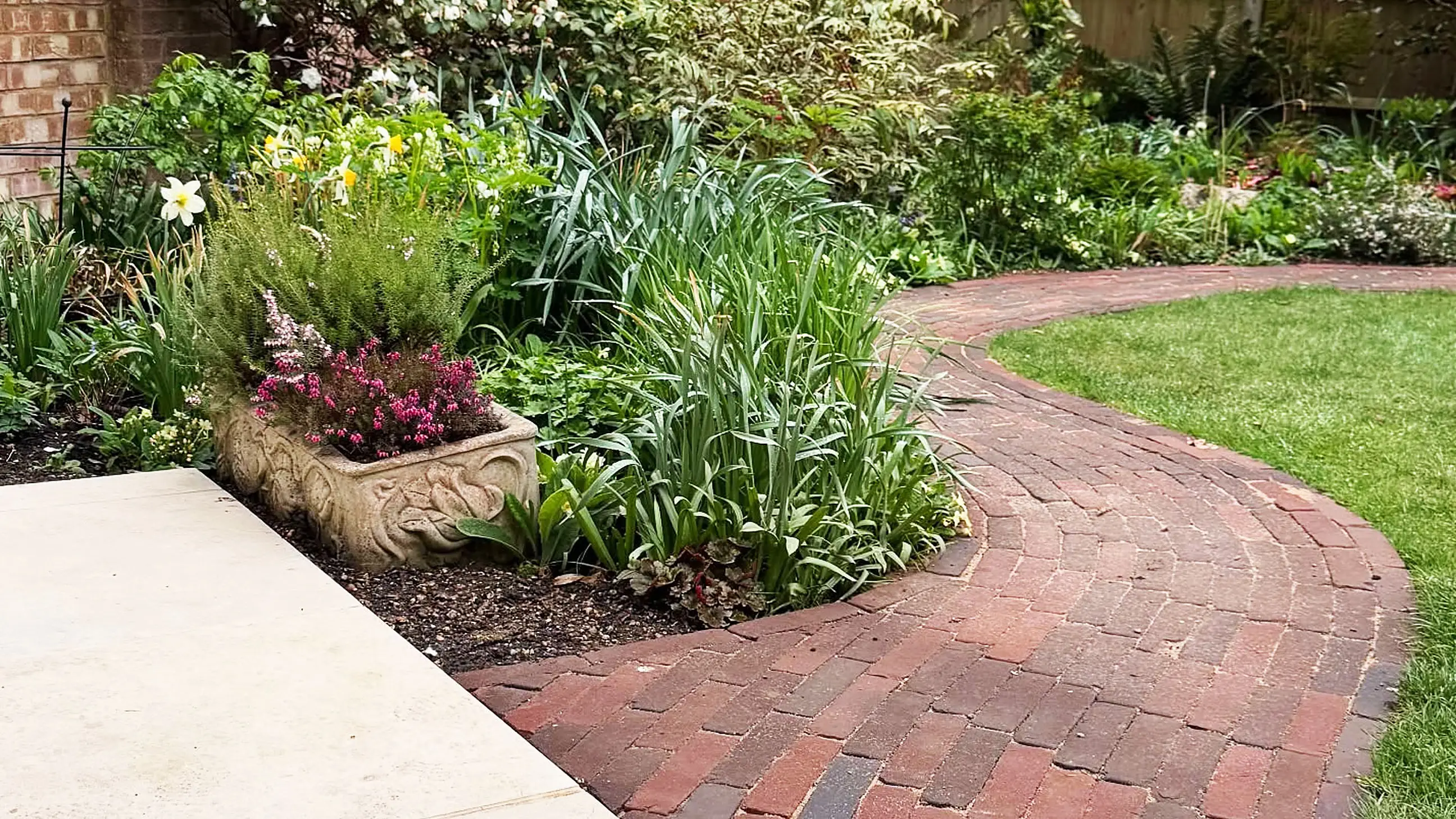
A curving brick path running through deep mixed planting

Neighbourhoods and villages

  • Wentworth Estate
  • Wentworth West, known locally as The Island
  • Wentworth East
  • Virginia Water Centre, the village centre at the station
  • Trumps Green
  • St Ann's Park and Virginia Park
  • St Ann's Heath
  • Callow Hill and the Crown Estate
  • Stroude Valley
  • Knowle Hill
  • Trotsworth
  • Sandhills Court and The Orchard
  • Stroude
  • Thorpe Green
  • Longcross

Postcodes we cover

GU25, TW20

Planning and trees

Runnymede Borough Council is the planning authority here, with Surrey County Council as highway authority for the adopted roads and as lead local flood authority. There is no designated conservation area in Virginia Water itself, so the conservation area tree notice does not usually apply in the village, although it will on jobs just over the boundary at Englefield Green or Thorpe. The Neighbourhood Plan does use the phrase Cabrera Conservation Area for the river corridor in a nature sense, but that is not a designated planning conservation area and should not be treated as one.

Trees here are generally protected two other ways instead. Where a tree carries a Tree Preservation Order, consent is normally needed before work, and dead or dangerous trees are handled as an exception with their own notification requirement, which is worth confirming with the council for your particular tree rather than assuming. On top of that, the Wentworth Estate Roads Committee enforces the title covenants, and one of those generally requires the Committee's prior written approval before a tree above a set girth is felled, with replacement expected on a one for one or in some cases two for one basis.

The Virginia Water Design Code asks for mature frontage trees and hedges to be retained and bolstered on Crown Lane, Crown Road, Trumps Green Road, Knowle Grove and Wellington Avenue, and along Callow Hill, Bakeham Lane and Prune Hill, and for the ancient woodland between the two parts of Knowle Grove to be left alone. Much of the village, including Wentworth West, the Crown Estate land and the Stroude Valley, is Green Belt, where new development has to preserve its essential openness, and the Stroude Valley is also the designated Local Gap between Virginia Water and Egham, so garden rooms and outbuildings are worth checking early rather than late. The area sits inside the buffer zone of the Thames Basin Heaths Special Protection Area as well, and local guidance asks for native or climate resilient species, for grey and rainwater harvesting where it is possible, and for habitat measures such as bat boxes, swift bricks and hedgehog routes.

All of this is guidance and private covenant rather than a fixed entitlement, so we would always ask the council or the Committee about your plot before the work is priced.

Recent work

Gardens Built on Ground Like This

  • Cottage garden borders in full flower around a stone water feature
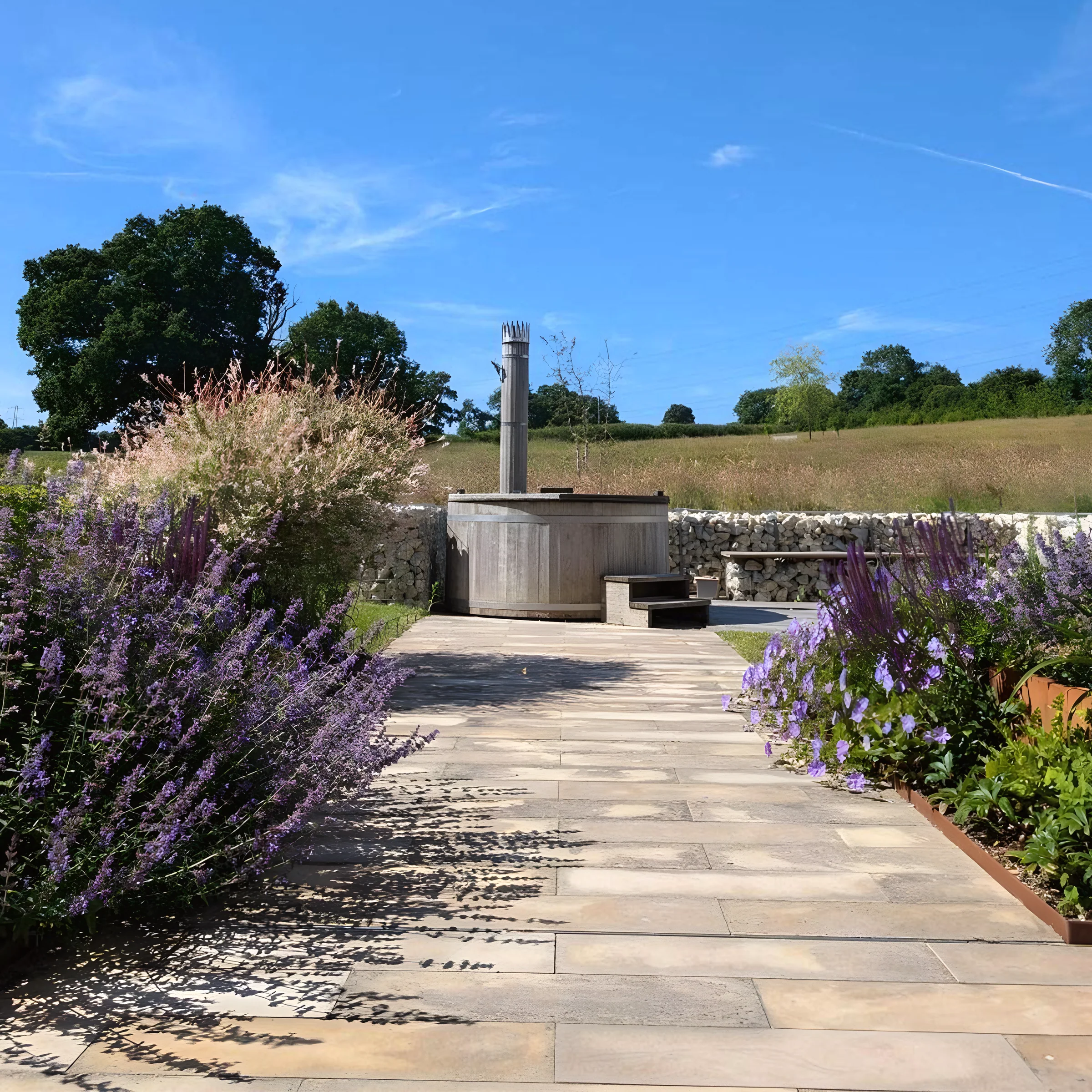
  • Lavender in flower along a stone path
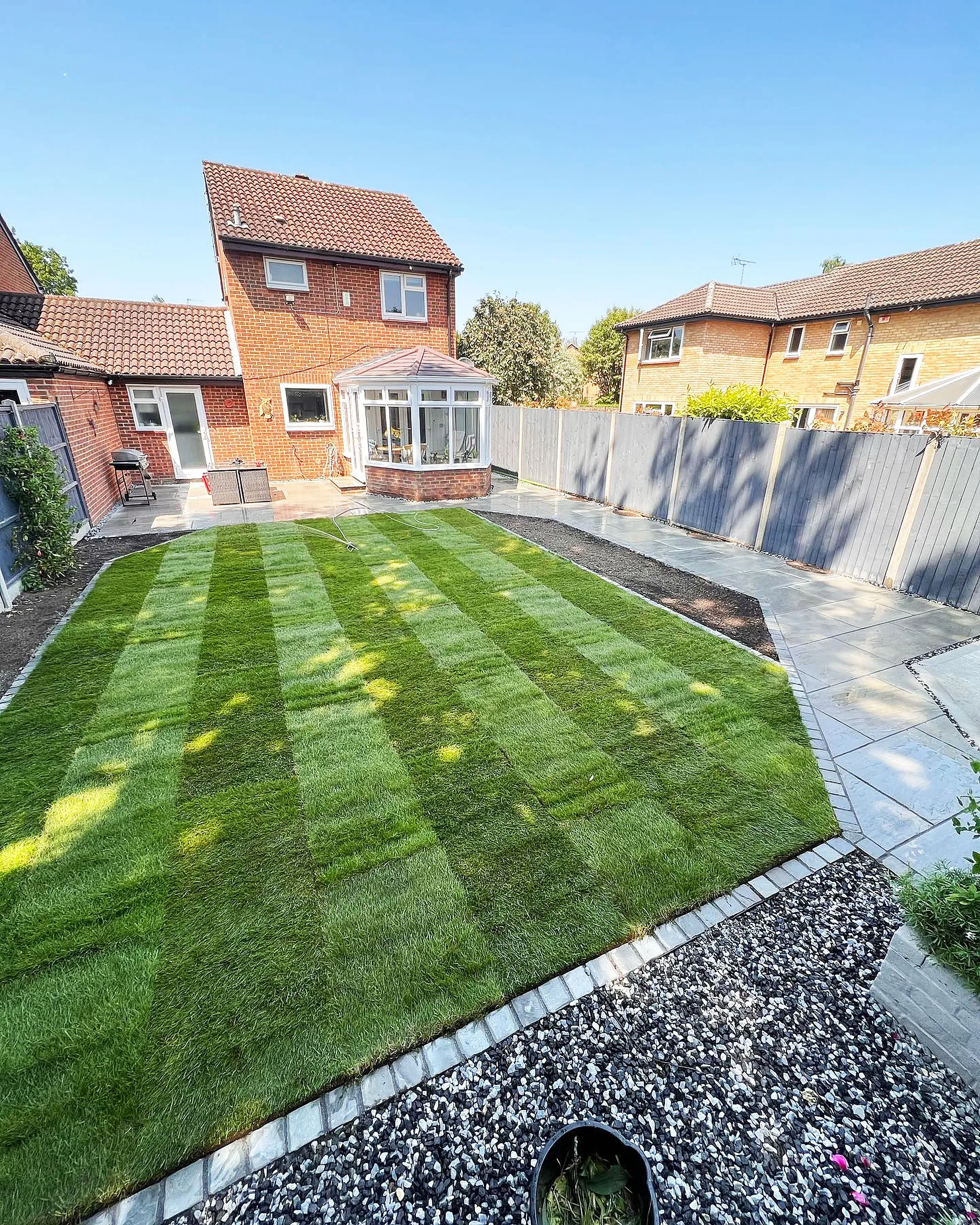
  • Stone paving laid in long bands beside a lawn

Good to know

Virginia Water Questions

Do You Work Inside the Wentworth Estate?

Yes, and we work to the Estate's own process rather than around it. Its guidance is that an owner enters a Deed of Agreement with the Roads Committee before work starts on site, with a meeting between you or your professional advisors, us as the appointed contractor, a representative of the Committee and a representative from the security company. Plant, deliveries and skips are arranged through that, and any verge or ditch crossing we have to make is kept to what the Committee has already approved.

Why Is One Half of My Garden Parched and the Other Half Waterlogged?

Because of what is under it. Virginia Water sits on Bagshot sand, which water runs straight through, but there are thin beds and pockets of pale grey clay inside that sand and the whole sequence rests on London Clay. Where water meets one of those it perches or comes out as a spring line, so a dry front lawn and a boggy bottom corner on the same plot is normal here rather than a fault. We read the ground before we set any levels.

What Will Actually Grow Well on This Soil?

The acid lovers, and they will grow well with very little persuasion. Rhododendron, azalea, camellia, pieris, magnolia, heather, Scots pine, birch and oak are all at home on this ground, which is exactly what the Valley Gardens on the northern shore of the lake demonstrate with their collections of magnolia, rhododendron and Glenn Dale azaleas. Lime lovers, most roses and anything approaching a kitchen garden need a made soil first, and then they need keeping fed.

Can I Take a Tree Out to Open the Garden Up?

Check before you plan around it. A Tree Preservation Order means consent is normally needed first, and on the Wentworth Estate a title covenant also requires the Roads Committee's written approval before a tree over a certain girth is felled, usually with a replacement expected in its place. The Design Code asks for particular tree clusters and frontage hedges to be kept as well, including the ancient woodland between the two parts of Knowle Grove. We find out what applies to your specific tree before anything is priced.

Can You Get Machinery Into a Garden at Trumps Green?

Usually only through a side gate, so material is barrowed through and the sequence of the build is planned around that. Access to the village itself is good: the A30 runs along the north and the M25 is close at Egham and Thorpe, so plant and muck away are straightforward to the edge of the village even when the last part is not. The height restriction on the railway bridge at Trumps Green Road means anything large coming from the Longcross side routes round rather than through.

Do You Look After the Garden Once It Is Built?

That is the point of doing both. The same in house team that designs and builds a garden is the team that looks after it afterwards, which matters more on sand than it does on better ground, because the top layer has to be built up every year and the irrigation needs managing through the summer. Garden maintenance plans start from £160 per month on a twelve month agreement, with a minimum four hour visit each month, and for larger houses and grounds we run estate level care on a planned calendar instead.

Close by

We Also Work In

Start your garden

Let Us Look at Your Ground First

If you are planning a garden in Virginia Water, a walk round the plot tells us more than a brief does. We will find where the Bagshot sand gives way to the clay underneath it, work out which corner the spring line feeds, check whether the way in is a private Estate road or a side gate at Trumps Green, and put a proper figure against it.

  1. 01
    We Call You BackWithin one working day, to talk the garden through.
  2. 02
    The First VisitA walk round the garden to take in the levels, the access and where the water sits.
  3. 03
    A Written ScopeA specification and a programme, with samples to see in your own light.
Prefer to talk?01276 582095info@cjlandscapesltd.co.uk
1 Webbs Mews, High Street
Hartley Wintney, Hook RG27 8NZ
What Would You Like Help With?

Choose as many as you like.

Tell Us About the Project

Roughly is fine. It helps us bring the right people to the first visit.

Your Details
Photographs Optional, up to five

Thank You

Your enquiry has come through and we will call you back within one working day.

Step 1 of 3

We only use your details to reply to this enquiry.